
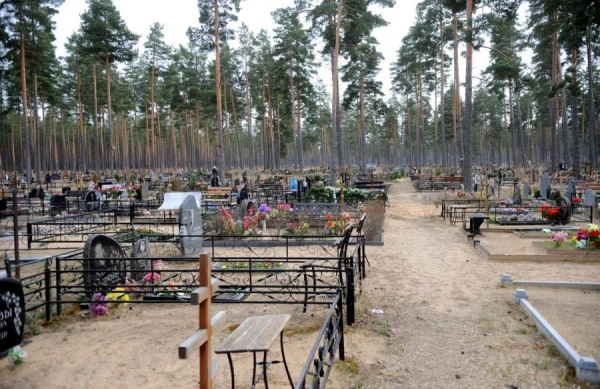
In the concept for the development and management of Riga's cemeteries, one of the central issues is the exhaustion of capacities for traditional burials, which, according to the municipality's assessment, may become critical in certain scenarios as early as 2033. One possible solution being considered is the development of memory gardens for urn burials.
As noted today at the presentation of the concept for the development and management of cemeteries in Riga for 2026–2035 at the Town Hall by the Deputy Chairman of the Committee on Housing Policy and the Environment, Edgars Ikstens (JV), the document does not provide for radical changes. The concept is not "set in stone" — it is a foundation that can be refined. The main principle is respect for the deceased and the preservation of cultural and historical heritage.
The document concerns 22 municipal cemeteries. Eighteen significant challenges have been identified, grouped into four problem areas. The first is the exhaustion of spaces for traditional burials and limited opportunities for expanding territories. The second is the lack of financial and human resources for maintaining cemeteries. The third is the increasing burden on the environment and infrastructure, including waste disposal and landscape maintenance. Additionally, issues with data accounting and regulation have been noted, complicating the accounting and management of burial sites.
The proposal to intensify the accounting of neglected graves has sparked a broad discussion. According to the current rules of the Riga City Council, places that are not maintained are subject to recording. If it is established that a site has not been cared for for three consecutive years, a corresponding act is drawn up.
Neglected graves are available for reburials (above-ground). If at least 20 years have passed since the first burial, other deceased individuals can be buried at these sites both traditionally and in urns.
During the discussion, a proposal was made to extend the recognition period for a grave as neglected from three to five years, arguing that many residents live abroad and visit graves less frequently. It was also suggested to require the preservation of memorial plaques during reburials to avoid losing historical evidence.
In response, it was clarified that recording is conducted only for long-abandoned sites, while objects of cultural and historical value are excluded from this process. The three-year period is considered a time frame to confirm the prolonged absence of care. Council representatives noted that the proposal to preserve monuments during reburials deserves consideration, but aesthetic and practical aspects should be taken into account.
Currently, the possibilities for surveying and drawing up acts for neglected graves are limited. As of October last year, 625 graves had been recorded (the most — 182 — at the First Forest Cemeteries; at the left bank of the Daugava cemeteries — only 230). However, this figure does not reflect the actual number of abandoned sites.
In the long term, the experience of Germany can be considered, which provides for the release of a site 20 years after burial. This would allow for new traditional burials instead of reburials, which in some cases are complicated due to high groundwater levels.
New burials in released sites may be more in demand, as they do not require the preservation of the previous deceased's monument and the maintenance of double records in the system.
Possibilities for expanding territories were also discussed, taking into account zoning and groundwater levels. In some places, expansion of areas is possible, while in others, it is advisable to develop urn burials and memory gardens.
According to estimates, fields for scattering ashes could become a modern, environmentally responsible, and compact alternative to traditional burials, reducing the burden on existing territories.
Potential sites for such solutions include the cemeteries of Jaunciems, Bolderāja, Lāčupe, First Forest, as well as the cemeteries of Sarkandaugava and Martin.
A competition has been announced for the construction of a columbarium; the concept also provides for further development of columbarium infrastructure.
To enhance financial sustainability, the differentiation of fees for spaces in "prestigious" cemeteries is being considered, along with the continuation of digitization of records and the regulation of the status of abandoned monuments. Special attention is planned to be given to waste management issues, including the creation of composting sites, and preventing cemeteries from turning into illegal dumps.
Two models for organizing composting sites have been proposed. The first is the creation of a large (approximately 5 meters in diameter) site for collecting biodegradable waste (leaves, flowers, wreaths without plastic, branches) with a separate container for household waste. This will allow for centralized accumulation of biological material and reduce disposal costs.
The second model involves a separate composting site where biological waste is not only collected but also processed on-site to produce compost that can be used for maintaining the green spaces of cemeteries. Nearby, a container for non-recyclable waste is installed. This system will enhance resource management efficiency and reduce transportation volumes.
The plan emphasizes the need to allocate resources for maintaining alleys and elements of the cemetery landscape.
The report is about 80 pages long with more than 20 appendices. The public discussion will last until February 26, and residents can submit proposals regarding priorities and the regulation of cemetery development.
The draft concept can be reviewed on the municipality's website, and proposals can be submitted until February 26 as part of the public discussion.
It is also reported that a Cemetery Law is being considered in the Saeima, which provides for unified regulation of issues related to the creation, maintenance, expansion of cemeteries, and the provision of burial spaces.
With the enactment of the law, municipal cemetery usage rules will become invalid. A transitional period is provided — existing rules apply if they do not contradict the new regulations, but no later than June 30, 2027.






Leave a comment