In Latvia, more than 4,000 people suffer from Parkinson's disease. The diagnosis is increasingly being made for younger individuals.
Modern medications and therapy would allow them to live a full life, but they are unavailable in Latvia. Both Lithuania and Estonia offer therapies that improve the lives of Parkinson's patients. Latvia also has the equipment and specialists capable of providing this, but the service is unavailable even for payment. The program "Nekā personīga" (TV3) together with students from the University of Stradiņš in Riga, Lucija Baline and Eliza Berzine, investigated why this is happening.
Normunds Egle was an entrepreneur in the Virga municipality for 30 years, supplying spare parts for agricultural machinery. Thirteen years ago, he fell ill — doctors diagnosed him with Parkinson's disease. He was 50 years old at the time. Daiga Egle recounts that before the illness, Normunds had a business and was an employer himself.
"He founded three companies, participated in their work, and managed them, but five years ago this became impossible," says Egle.
Normunds himself shares that he was forced to sell the companies because he could no longer work. He sold them successfully.
"It became difficult to handle everything. Then I also tried to work at a local kindergarten, in the municipality — as a facilities manager, but that also became impossible, everything became quite dangerous," Normunds candidly states.
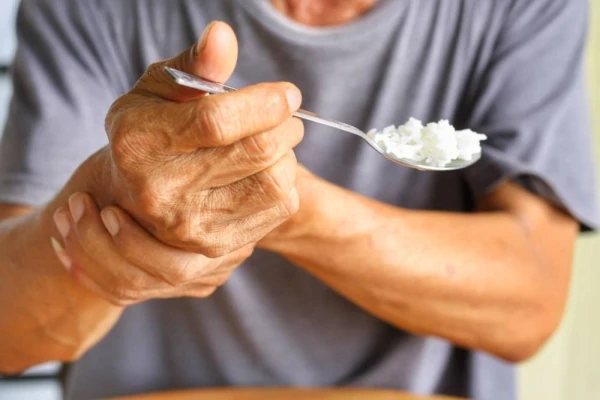
Currently, the situation is better, notes Daiga. "Now it’s very good, he has rested well, the medications are working well now, but it won’t last long. Now it’s at a stage where strong panic attacks come, the whole body twists, the left side goes numb, it’s hard to breathe, it feels like the heart is stopping," she describes the symptoms of the disease.
For the last two years, Normunds has been at home. His wife takes care of him around the clock.
As the disease progresses, medications have to be taken more frequently and in larger doses. Normunds takes nine pills every two hours. The state only reimburses 75% of the cost. Previously, all expenses for Parkinson's patients were covered, but nearly 20 years ago, during a crisis, support was reduced.
Only short-acting medications are available in Latvia. Over time, their effectiveness decreases, and stronger medications are not sold here. They have been used in Europe for decades. As an experiment, Normunds is also taking one of these medications. He spends several hundred euros on medications each month.
When medications stop helping, but the disease has not yet reached its final stage, patients can have a brain stimulator implanted. Until 2009, such surgeries were performed at the Stradiņš Hospital. The equipment and specialists are still available, but there is no funding. The surgery is available in Estonia and Lithuania. The cost of implantation is about 30,000 euros. Some patients previously had their surgeries covered by the state in neighboring countries, but now funds are not allocated for this.
Guntis Karelijs, head of the neurology and neurosurgery clinic at RAKUS, noted at a Saeima commission meeting:
"The results are simply fantastic. These people are able to work, they go to their jobs. One even changed jobs for a better one."
Normunds was one of six patients for whom a medical council recommended surgery in Estonia last year, but the National Health Service refused to fund it. Doctors are sounding the alarm and in December appealed for help to the Saeima's subcommittee on social and labor issues. Only two out of nine committee members attended the meeting.
Neurologist, chair of the Latvian Society of Movement Disorders Ligita Smeltere stated at the commission that in Latvia, it seems, everything is in the "red zone" — absolutely nothing is available.
Daiga Egle recounts:
"The operation for my husband was scheduled for January 13, and we are the family that was denied this year. Both the National Health Service and the Ministry of Health sent a three-page letter stating that there is no money. If you already have the wires and stimulator — we can pay for them, but nothing more. It was a very, very painful letter. Now our family is raising 30,000 euros — we need to go to Estonia."
Six years ago, the Cabinet of Ministers excluded the surgery from the list of permitted procedures in Latvia. No one understands why. This means that the surgery abroad on the recommendation of the council is no longer funded. Waiting is not an option — one can miss the moment when therapy is still effective.
Neurologist Krista Lazdovska notes that Parkinson's disease affects not only the elderly but also quite young people of working age.
"I have several patients with disabilities who receive a pension only because these treatment methods are unavailable to them," she says.
To fully reimburse the medications already available in Latvia, the budget needs about 200,000 euros. To reimburse modern medications — about 14 million euros, calculated the NHS. After discussions in the Saeima and an international conference of neurologists, the process has moved forward, and the Ministry of Health promises to seek funding.
Sanita Janka, director of the health department at the Ministry of Health, states that the introduction of two new medications would significantly improve the lives of patients and allow them to work and pay taxes.
Overall, however, the budget lacks about 300–400 million euros for medications and other healthcare services. This means that the problem concerns not only Parkinson's disease.
The State Audit Office notes that there is not enough funding for everything, but the distribution of funding is often unclear and illogical.
Maya Abolinya, a member of the State Audit Office Council, emphasizes that the budget is allocated based on available funds, not on the real needs of people and priorities.
Disability affects not only the patient but also the entire family, which becomes the caregiving side and recipient of benefits.
Daiga Egle admits that she feels alone with the disease. "We fight as best we can, we are alone with our illness," she says on the program "Nekā personīga."
Normunds and Daiga decided to raise the money themselves. Their sons cut down trees, and the missing 13,000 euros were donated by people through the portal "Ziedot.lv" on the last day of the year. A long recovery path lies ahead, but already a month after the implantation, Normunds can manage without injections.
Doctors and patients do not believe the ministry's promises. Seeing the low interest from deputies, they posted an initiative on the portal "Mana Balss" demanding full reimbursement for medications and ensuring modern medications and therapy in Latvia.