
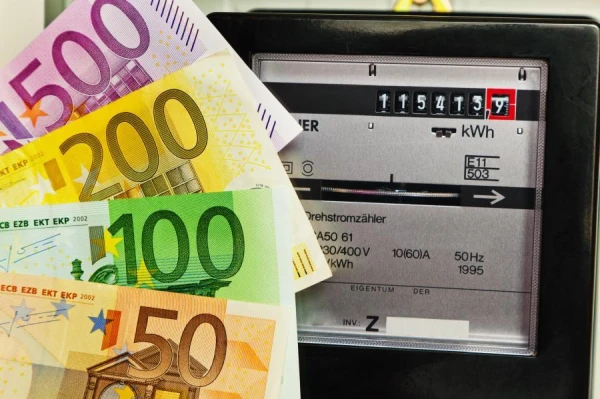
For many households, February brought an unpleasant surprise — electricity bills for January turned out to be significantly higher than usual. For some residents, they nearly doubled. On social media, people share specific examples: instead of the usual approximately 70 euros for January, they had to pay 147 euros; others report an increase of 40 euros, and in some cases, the bill even rose by 127 euros.
In January 2026, the average electricity price in the Latvian trading zone jumped to approximately 153.4 EUR/MWh — an increase of 83% compared to December. Price increases were also felt in other European countries, according to a market review by AS Augstsprieguma tīkls.
In the Baltic countries and their associated trading zones, the price increase in January was mainly driven by low air temperatures, which increased consumption. With rising demand, more expensive sources of electricity generation had to be utilized more frequently to cover the total consumption. Additional impact on household expenses came from changes in distribution tariffs — AS Sadales tīkls had previously warned that starting from January 1, 2026, the monthly fee for capacity maintenance would increase for some residents due to the conclusion of the state support mechanism introduced in 2023, which had limited the sharp rise in tariffs for individuals.
The portal Jauns.lv contacted the Ministry of Climate and Energy to find out whether new state support measures or targeted compensations are being considered in the current situation, as well as what practical steps (reviewing connection capacity, changing tariff plans, etc.) could realistically help reduce bills.
Ministry: most households use a fixed price, but bills increased due to consumption "Overall, when it comes to the electricity bill, which consists of the electricity price, system services, and taxes, about 85–90% of Latvian households use fixed-price contracts. These households are not affected by wholesale market fluctuations. Although the average retail electricity price in Latvia is currently even slightly lower than in January 2025, January bills turned out to be higher due to increased consumption.
The total electricity consumption in Latvia in January (according to preliminary data) reached 751.2 GWh, which is approximately 14% more than in January 2024. In the household segment, the increase is related to the use of electricity for heating homes."
Electricity distribution tariffs in 2026 remained unchanged. However, from January 1, 2026, the state support mechanism that had been in effect since 2023, which limited the sharp rise in tariffs for individuals, concluded. This affected the actual charge for distribution services for the most common connections (with a capacity of 16–25 A) under the "Pamata" tariff plan.
For households with single-phase connections, the monthly fee for capacity maintenance increased by 0.20–1.26 euros excluding VAT (depending on the selected capacity), while for three-phase connections, it increased by 1.92–3.50 euros excluding VAT. These changes do not affect households that were previously not covered by state support (connections of 32 A and above), nor legal entities — for them, the actual charge in 2026 remains unchanged.
Most households with single-phase connections will face an increase of 0.20–0.56 euros per month. The largest increase — up to 3.50 euros per month — will affect users of three-phase connections at 25 A.
Support for protected groups and payment deferrals
In 2026, protected electricity consumers (low-income and needy individuals, large families or families with disabled children, individuals with Group I disabilities) will continue to receive state support of 20–25 euros for electricity payments. No application is required — the discount is automatically applied to the bill.
The Ministry also reports that with the onset of cold weather, weekly meetings are held with responsible institutions and energy companies to discuss the situation with energy supply and energy resource prices. It is emphasized that the supply of gas and electricity in Latvia and the Baltic countries remains stable even during prolonged frosts.
Residents facing financial difficulties have access to payment deferrals — each case is considered individually. There is also a housing benefit mechanism provided by municipal social services. From January 1, 2026, the circle of beneficiaries of this benefit has been expanded.
How to avoid unpredictable bills?
The Ministry recommends considering consumption patterns. Those who use electricity for heating and cannot flexibly adjust consumption based on market prices are advised to consider entering into a fixed-price contract for the heating season.
At the same time, during warm weather, contracts with dynamic pricing can be used, when consumption is easier to plan (for example, for heating water, cooling rooms, or charging electric vehicles), choosing hours with lower tariffs.






Leave a comment