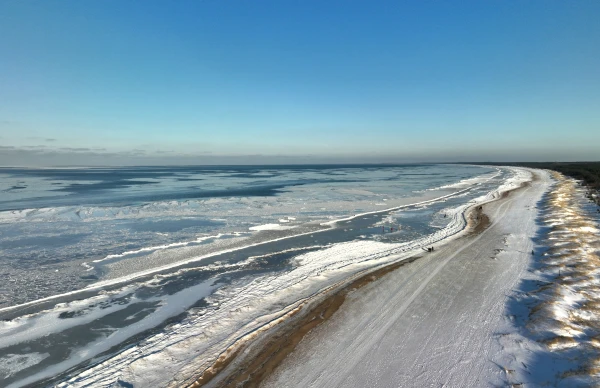
Due to the prolonged eastern wind, the water level in the Baltic Sea has dropped this week to one of the lowest values in recorded history, measurements show, reports LETA.
In the Åland Islands, the water has receded to 72 centimeters below the average sea level, setting a new record since observations began in 1924.
Off the coast of Latvia, the water level in the sea has dropped approximately 65 centimeters below the zero mark of the Latvian height system, according to data from the Latvian Environment, Geology and Meteorology Centre (LEGMC).
In Liepaja and Ventspils, the water level in the sea has approached the lowest marks in recorded history. In Liepaja, it was a few centimeters lower in 1937, and in Ventspils, it was in 1978.
In the Gulf of Riga, at the end of January in 2010 and 2014, the water level was 10–20 centimeters lower than it is this week, and the lowest level in the history of observations in the gulf was recorded in 1959.
In the coming days, with a moderate eastern wind persisting, the water level in the sea may drop another few centimeters.
The low water level is beneficial for the "health" of the Baltic Sea. When the wind shifts to the west, cleaner, saltier, and oxygen-rich water from the North Sea will flow into the Baltic Sea. The last major influx of such water occurred in 2014.
Due to the low water level in the Gulf of Riga and between the Estonian islands, the Estonian Environmental Agency has issued a warning about difficult navigation. A warning about low water levels is also in effect off the coast of Finland.
The ice cover in the Baltic Sea is at its largest since 2018, and it is expected that in the coming weeks, the ice coverage will be the widest since 2011.
It was previously reported that the icebreaker "Varma" has set out to break the ice cover in the Gulf of Riga for the first time since 2018.