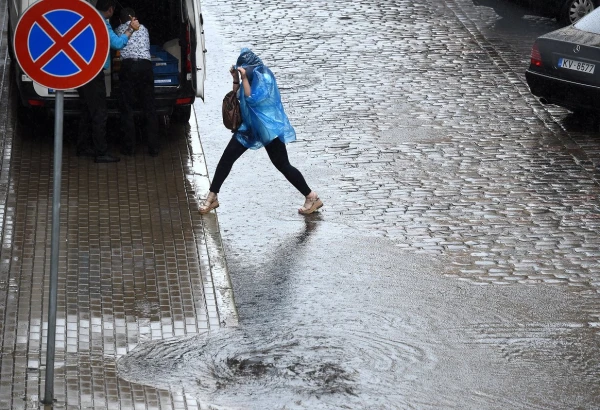
“Does the police have the right to fine a person for not having a reflector, and what law requires a pedestrian to have some reflective thing dangling from their clothing or bag? A reader from bb.lv”
Lina Bagdone, senior specialist in the Public Relations Department of the State Police:
– The traffic rules state that a pedestrian on the roadway or shoulder, during dark hours, if the road is not sufficiently and evenly illuminated, is required to wear a reflective vest or clothing with clearly visible reflective elements.
Violating these rules results in a penalty in the form of a warning or a monetary fine ranging from two penalty units (i.e., 10 euros) to six penalty units (30 euros).
From the Editor
Such a question during one of the recent “Hotlines” frankly surprised me. It seemed that after numerous explanatory campaigns conducted over many years by both the police and insurers, there should be no one left who does not understand how important it is to be visible, especially at night and particularly on roads with insufficient (or no) lighting. But it seems that not everyone is clear on this yet. Therefore, we decided to draw attention to this important issue once again.
However, a fine, even the maximum one, is the least of the troubles that can befall a person who has become an “invisible” figure on a dark or poorly lit road.
Such a requirement did not arise out of nowhere, but based on an analysis of the causes of traffic accidents over many years! According to studies, in conditions of poor visibility (darkness, fog, rain, snowstorm, etc.), a pedestrian with reflective elements becomes visible to a driver from a much greater distance.
For comparison: if a car is moving with low beam headlights, the driver will see the “invisible” pedestrian only when approaching within 25-40 meters. But if the pedestrian has reflectors, this distance immediately increases to 130-140 meters. And high beam headlights will allow the driver to distinguish the pedestrian from as far as 400 meters!
Accordingly, reflective elements on clothing give the driver additional time to make the most appropriate decision — to slow down, to signal in time (if necessary), etc. — to avoid a traffic accident. Possibly with tragic consequences.
It should also be understood that the presence of a reflector alone does not provide additional safety; it is important that it is visible. Clothing, bags, backpacks, etc., where reflective elements are already sewn in, are most effective in this regard (not accidentally, they can be seen on almost all outer winter and transitional children’s clothing, as well as on the uniforms of people whose work is related, among other things, to outdoor activities).
However, on adult clothing and accessories, such protection is far from always provided — accordingly, a person must take care of this kind of safety themselves. This means that a reflector (and not just one, but several) should, firstly, be acquired in principle. Secondly, they should be placed in such a way that they are visible from all sides while moving.
If the ultimate goal is safety, then the best places for them are on the right and left (this is especially important on roads with two-way traffic), and ideally — on all sides.