
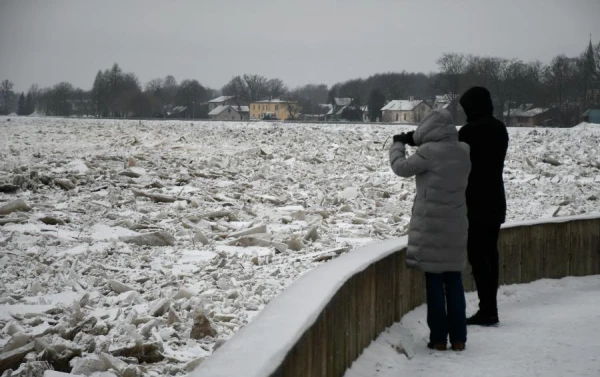
This week, the accumulation of shuga in the Daugava River near Jekabpils caused a sharp rise in water levels. Due to the effects of frost, the movement of shuga has stopped, but residents anxiously await the thaw, public media reports.
Hydrologists also predict that this year a thick layer of ice will form on the river, so a sharp rise in temperature could cause flooding. The municipality indicates that responsible specialists are prepared for crisis situations. After the water level in the Daugava River near Jekabpils rose more than a meter in one day, the regional administration began to monitor the situation more closely.
"We have started negotiations with residents who are most often affected by floods or are the first to be impacted by them; we have begun discussing the situation with them and monitoring it. So far, the best-case scenario has come true - the shuga flow has stopped, it has frozen," said the civil defense engineer of Jekabpils region, Ilmars Luksts.
Frost has contributed to a gradual decrease in the water level, and on Thursday, the water level in the Daugava near Jekabpils was 3.56 meters. This is more than two meters below the yellow warning level in the city. Hydrologists predict that frost will persist in the near future, and the situation on the river will remain calm, but problems may arise in the event of a strong thaw.
"During the freezing, many compressions formed in the Daugava, and the ice will be thick. At the beginning or end of spring, ice jams and a rise in water level are likely possible again, but it is too early to talk about that now. Usually, rapid processes cause larger and more serious floods," says hydrologist Liga Klints from the Latvian Environment, Geology and Meteorology Centre.
The city is protected from flooding by a restored protective dam on the Daugava, but residents of the municipalities upstream and downstream from Jekabpils, where there is no dam, feel less secure. In the village of Abeli, they still remember the flood from three years ago.
"The farms that were there - all of them were underwater, basements were flooded, bees were in the water. This had a significant impact on us. The bees did not die because we managed to pull them out of the water at the last moment. We constantly monitor how the Daugava behaves, what its water level is," says Gita.
Municipal civil protection specialists have developed flood action plans. To further reduce the risk of flooding, funds are planned to be attracted for the expansion of protective dams on the left and right banks in Jekabpils, raising four sections of streets, and other improvements to the protection system. If funding is allocated, construction is scheduled to begin in 2027.












Leave a comment