
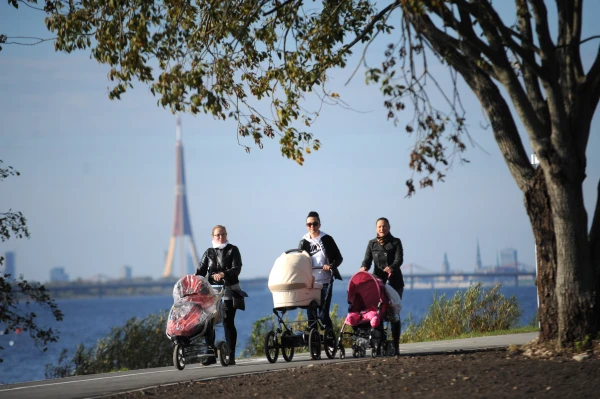
A pilot maternity assistance project starts on January 1.
It is even surprising how the overwhelming majority of the population of Latvia came into being — after all, this was during the years without widespread programs to stimulate childbirth. In general, humanity has been successfully managing this function for the last 300,000 years, which has allowed the species of primates Homo sapiens to populate the expanses of the Earth. In certain areas of the planet, such as Latvia, however, there is a bottleneck — and then the government rushes to help.
Efforts Against Violence
According to an information report prepared for the government of the Republic of Latvia by the Minister of Health Hosam Abu Meri (“New Unity”), the environment for future mothers in our republic is not very favorable, as approximately every eighth (13.2%) woman giving birth "suffered from physical, verbal, or emotional violence".
"The most significant problems include the lack of unified, clear information, unfamiliarity of the staff with the patients, and the failure to provide explanations about planned actions and examinations that could reduce stress for women and enhance positive experiences. Despite the fact that the overall data from the pilot survey demonstrate positive trends compared to data collected a year earlier, Latvia still ranked 13th out of 22 countries included in the pilot survey in terms of the quality of care provided to mothers and newborns."
As for the work of the media and social media, negativity also predominates: "Negative stories of the experiences of pregnant women or young parents or reports of accidents have been highlighted."
The Ministry of Health acknowledges that in Latvia, regarding postpartum care, the only specialist is the family doctor, who provides monitoring for young families. "Despite the regulatory requirement for postpartum screening, at this moment... there are not enough resources." As a result, within 6 weeks after childbirth, there is only 1 state-funded visit to a gynecologist. "Currently, healthcare does not provide for the awareness of the well-being of young mothers, namely, their psycho-emotional well-being, feeding skills, etc., as well as the need for assistance in the postpartum period."
Close Monitoring
The Ministry of Health updates the implementation of Cabinet of Ministers Regulations No. 611 "Procedure for Providing Assistance During Childbirth":
-
The first visit for pregnant women — by the 12th week — includes weight measurement, laboratory tests, blood type and Rh factor determination, and infection screening. A cytological examination is conducted to ensure a normal pregnancy and timely identification of deviations from the norm;
-
At 11-13 weeks, a first-trimester genetic screening is conducted, including a special ultrasound for possible pathologies, as well as a specific blood test.
-
From the 16th week, fetal heart activity is monitored, and a second (20th week) and, if necessary, a third ultrasound (34-36 weeks) are performed.
-
At 25-26 weeks, glucose levels are measured to prevent gestational diabetes.
-
At 35-37 weeks, a swab is taken to determine the possible presence of group B hemolytic streptococcus in the birth canal; if the microorganism is detected, this information is recorded in the Mother’s Passport for special attention from the staff.
-
Childbirth is funded by the state, with the use of epidural anesthesia. "Budget" births are also conducted with the participation of relatives. Within the first three days of the newborn's life, blood screening for 23 diseases is also funded.
“There are various tips on the internet”
Thus, the Ministry of Health directs future parents to the pages of the Center for Disease Prevention and Control, the Children’s Clinical University Hospital, the Riga Maternity Hospital, etc. The website ESparveselibu.lv reflects projects and events of the European Union for young families. All this — probably, it is unnecessary to mention — is available in Latvian and English.
Recently, the Latvian Association of Gynecologists and Obstetricians has also joined the process. It is proposed: "To provide accessible medical and social care, linking this to quality birth outcomes, as well as to expand state support for young parents. This would include a program promoting physical, psycho-emotional, and social health, initially covering pregnant women, mothers, and newborns, thereby contributing to positive experiences for young families. It is important to understand the needs of young parents and, based on this, provide recommendations..."
In practice, this should result in visits from a specialist, referred to in the state language as vecamāte, which can be literally translated into Russian as midwife or obstetrician. The first visit for the future mother is planned in the third trimester (visit duration 60 minutes), before childbirth, and the second — 10 days after discharge from the hospital, but no later than the 6th week (visit duration 90 minutes). Importantly, no minimal patient payment will be required for such visits.
However, under certain circumstances — if a vigilant midwife detects negligence from the future parents, "if necessary, she informs the social services of the municipality and the orphan court or the State Police."
The selection of midwives for this important function will be handled by the State Health Service, "according to specific assessment criteria, including education, certification of the healthcare provider, and completed training programs, as well as practical readiness to conduct home visits."
As part of the pilot project, from January 1 to December 31, 2026, midwife visits are planned in Riga and the regions. To test the new clinical algorithm, it is necessary to act promptly — as the national budget, skewed towards military affairs, has only found funds for 729 mothers. In 2024, 12,671 children were born in Latvia, which was 13.2% less than the previous year.
It seems that the strange number of planned examinations arose from the calculations of the Association — that they need 137.22 euros for 2 visits — and the amount of funds provided by the Ministry of Health, namely 100,000 euros. If Mr. Abu Meri believes that with this figure in hand, one can confidently face domestic depopulation, then, in my opinion, he is not only mistaken but should not be in his position at all.
For Experience — to Africa?
Well, in general, the number of births is a delicate matter. Few people ask the question, for example, why the lowest birth rates are found in quite prosperous Southeast Asian countries — such as Singapore, which our politicians love to cite as an example. And in South Korea, there is an absolute minimum of 0.9 births per woman, while a minimum reproduction rate requires 2.
On the other end of the pyramid are the poor, war-torn countries of Africa — Niger, Somalia, where the average number of children is 6-7. This, through simple mathematical calculations, gives an approximate indication that already in the 21st century, the black race will leave the majority — across our planet. Apparently, because they are not concerned with psycho-emotional nuances, but simply — give birth. As they have done for hundreds of thousands of years.













Leave a comment