If the forecasts of meteorologists are confirmed and unstable weather with positive temperatures during the day and negative at night establishes in Latvia in the coming days, the condition of gravel roads will deteriorate, and the driving conditions on them will become difficult, warns the State Agency "Latvijas valsts ceļi" (Latvian State Roads), writes LETA.
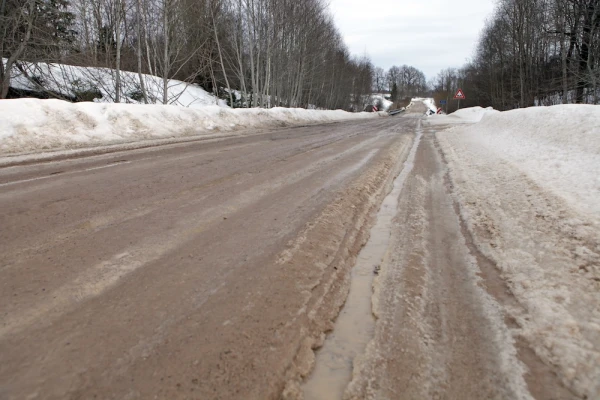
Under such weather conditions on gravel roads, depending on the region and route, both mud and icing are possible, as well as increased formation of potholes. In this regard, LVC recommends that drivers plan additional travel time and prepare their vehicles accordingly, including trucks.
Currently, weight restrictions of up to 10 tons for vehicles have been introduced on more than 120 sections of state gravel roads due to mud. Information about these sections is available on the map on the LVC website. The lifting of restrictions is not expected in the coming days. As the temperature drops, the damaged surface freezes, but not enough to carry out maintenance work. With warming, the over-saturated surface loses its load-bearing capacity again, notes LVC.
As the temperature drops, the gravel surface may become covered with ice and become particularly slippery. In winter, gravel surfaces are not treated with salt, as it destroys the surface by reacting with the gravel. In particularly dangerous places – at intersections and inclines – icy sections are sprinkled with sand, but during thaws, it quickly washes away. In snowy winters, gravel roads are maintained by compacting snow, and in dangerous areas, the surface is cut. Given that no snow cover is forecasted and temperatures will fluctuate, gravel roads may be particularly slippery.
Due to temperature fluctuations, potholes can form intensively not only in gravel surfaces but also in old, deteriorating asphalt. Maintenance of gravel surfaces in changing weather conditions is complicated and sometimes impossible, so timely leveling of potholes cannot be carried out. In winter, potholes in old asphalt are repaired using cold asphalt technology, explains LVC.
On sections of gravel roads affected by mud, weight restrictions for vehicles are introduced to prevent irreversible damage to the surface. Without restrictions due to mud, only emergency and public transport, fresh milk carriers, and vehicles removing fallen livestock are allowed to operate. For all other vehicles, restrictions are mandatory, and no special permits are issued. Compliance with the restrictions is monitored by the State Police.
Drivers should consider that wet weather affects the planning of current road maintenance work, and the effect of already completed work lasts only a short time. Due to heavy traffic on wet roads, potholes and depressions form more quickly, especially on routes with heavy vehicle traffic.
Maintenance work on roads is only possible after they dry out, as quality maintenance is impossible on over-saturated surfaces, explains LVC. However, in sections with particularly poor surface conditions, repair work is carried out in the most critical places, leveling only the top layer of the surface to a depth of 3–4 centimeters.