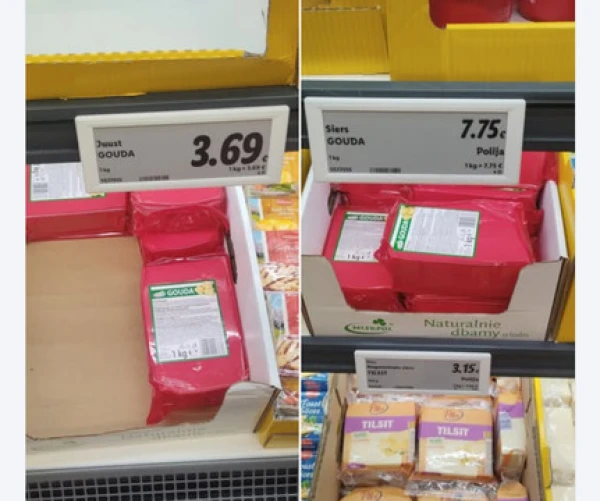
It is not news that food prices in Latvia are higher than in other EU countries. And here is yet another glaring confirmation: the same cheese from the same retail chain is sold to Latvians at twice the price as to Estonians, reports the Grani portal.
On Facebook, one participant posted two photos.
In one, there is a package of "Gouda" cheese displayed on a shelf in Latvia, with a price tag of 7.75 euros underneath. In the other photo, the same red package of "Gouda" cheese is displayed on a shelf in Estonia, with a price tag of 3.69 euros underneath. This means that the same retail chain offers the same product in our country at twice the price as in the neighboring one.
But why? Do retail chains consider Latvians to be very wealthy or very foolish? What is going on?
Representatives of Lidl thoughtfully stated that pricing in different countries can vary dramatically because it depends, among other things, on the "market situation" and the "purchasing power" of consumers.
So, they really do think we are idiots. Because Estonia is not on the other side of the world; it’s just a stone's throw away, and all Latvians know that earnings there are much higher than ours (the average salary in Estonia is 2126 euros compared to Latvia's 1757 euros, and the average pension in Estonia is 817 euros compared to Latvia's average of 628 euros).
Thus, the logic is upside down: you are poor, pay more.
The only fair argument that could actually influence the price of cheese was mentioned by Henrik Danusevich, the president of the Latvian Traders Association. He reminded that in Latvia, unlike Estonia, price tags must display the flag of the country of origin, which increases costs and, consequently, prices.
Well, that is true. When our lawmakers, satisfying their purely political ambitions, adopted such an amendment to the law, they clearly didn’t care that it would raise food prices. Well, we — the ordinary consumers — are the ones paying for it.
But still, acknowledging that the new price tags have somewhat increased the expenses of retailers, let’s ask again — it can’t be twice as much, right? Then why has the product become twice as expensive?
The answer is obvious; it lies in the failure of our authorities' economic policy, which has completely lost control of the situation. After all, how many times have they sworn to us to curb the appetites of retail chains that mark up products literally from thin air, how many promises have they made to negotiate with them to lower food prices?
And what? Nothing. If you take the Prime Minister, the Minister of Economy, the heads of other relevant departments, and ask them: how much does cheese, bread, meat, eggs cost today, there are serious doubts that they are aware. It’s not their personal problem. It doesn’t affect their careers.
They generously make promises, do not fulfill them, but remain in place. This means that food prices will continue to sharply contrast with the prices of our neighbors.