
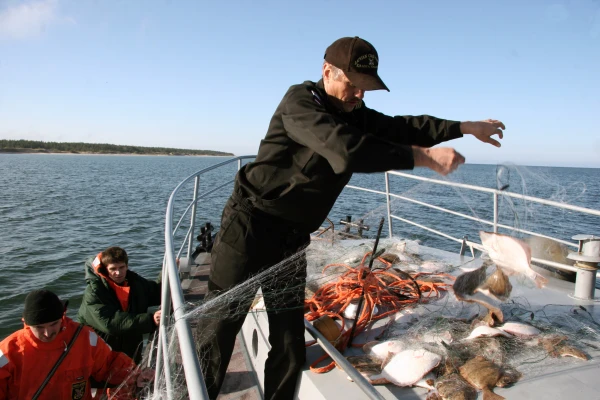
How to balance the interests of nature conservation and coastal fishermen? This question is particularly relevant for many representatives of this historical profession, as the public discussion of a new nature conservation plan in protected marine areas has begun. The plan provides for serious restrictions on any economic activity in a vast coastal zone, including a ban on fishermen going to sea, reports TV3 News.
The measure is aimed at preserving the ecosystem of the Baltic Sea. On Friday, December 5, the first public discussion of this plan took place in Salacgriva, and at times the discussion was heated.
This is the end of coastal fishing. Representatives of this profession are concerned about the plan, which proposes a complete ban on any economic activity in vast marine areas, including fishing.
On the eve of the public discussion in Kuivizi, journalists met with two fishermen working on the rocky seacoast of Vidzeme. Here, in the fifth generation, Janis Kruminsh continues the work of fishermen. He says: if the restrictions are as strict as proposed now, the profession will disappear.
"If this marine protection plan is adopted, it will be a huge blow to all fishermen because, in essence, all the most active fishing areas will be prohibited. And we will no longer be able to catch fish. We will have to travel tens of kilometers, transport all boats, all large fishing gear — it’s unrealistic," Kruminsh explained.
Nikolai, who goes to sea from Salacgriva, shares the same opinion.
"This means that for us, small coastal fishermen, it’s all over. You can pack your belongings and leave the sea — sit on the shore... I have been in fishing for over 20 years, actively in recent years. To throw all this away? What should I do with all this wealth? All the sheds are filled with traps, nets… People want to eat fish. What will we buy — Norwegian fish? No way. We must fight this bureaucratic office," Nikolai Kolushkin is convinced.
Therefore, on December 5, many residents of Vidzeme gathered in the center of Salacgriva, where the public discussion took place.
It was held at the office of the Nature Conservation Agency in Salacgriva — almost symbolically, as an old fishing boat stands by the building. Fishermen stated: if the plan is adopted in its current form, their fishing gear and boats could also be displayed at the office — as museum exhibits.
On December 5, nature conservation experts explained that new protected marine areas are necessary both due to European regulations and the urgent need to preserve and restore the biodiversity of the Baltic Sea.
Thus, scientists concluded that it is important to preserve valuable bubble algae — an important part of the marine ecosystem. Therefore, ecologists propose to declare a significant part of the coastline a protected area. In Vidzeme, the potential protection zone is designated from Salacgriva to Tuija. In this territory, economic activity will be prohibited — fish can only be caught from invasive species, such as the round goby.
"I don’t want to offend anyone, but you sit in an office in a chair and you think: 'Oh, he is causing harm.' Excuse me, what harm? Tell me. As a coastal fisherman, what harm am I causing? Here in Salacgriva, there are maybe ten families left who earn and pay you a salary — and you want to eliminate them?" expressed confusion fisherman Roland Kirsis.
"The industry will be economically destroyed. And the result will be the same: algae and all biotopes will disappear," another resident of the Limbaži region is convinced.
The leadership of the Limbaži municipal council also expressed misunderstanding regarding the plan on December 5. After all, in addition to economic restrictions, seasonal bans are proposed for bird protection — from March to August, the movement of any vessels is prohibited in certain areas.
"At the moment, if you look at most of the territory, it is not suitable for economic use at all. We can no longer implement professional training — sailing, rowing. We need zones that were used for training. As one woman said at the meeting: you should be happy that you now have a reserve. What is there to be happy about? That my residents will leave because there is a reserve and we can’t do anything?" pointed out the chairwoman of the Limbaži municipal council, Sigita Upmale.
The Nature Conservation Agency emphasized after the meeting that the plan is still in development, and it contains the maximum possible restrictions. That is why such discussions are being held — to listen to all sides and try to reconcile their interests.
"Certainly, there are areas where something needs to be reconsidered and ensure the protection of algae. But that’s the whole point — scientists always want the maximum, while the people who live there do not. They want to work. And we are somewhere in the middle. Whether we like it or not, as the Nature Conservation Agency, we must find a golden mean. I don’t think that in the end, the maximum from both sides will remain, but we are indeed interested in finding a solution that is more or less acceptable to everyone," explained the director of the Nature Conservation Department of the Nature Conservation Agency, Gita Strode.
Public discussions of this plan will continue — in Kolka, Kemeri, and Gavieze, as similar restrictions are proposed not only on the Vidzeme coast but also in several areas of Kurzeme — in Lapmežciems and Ragaciems, in the Vergale municipality and Jūrmala.












Leave a comment