
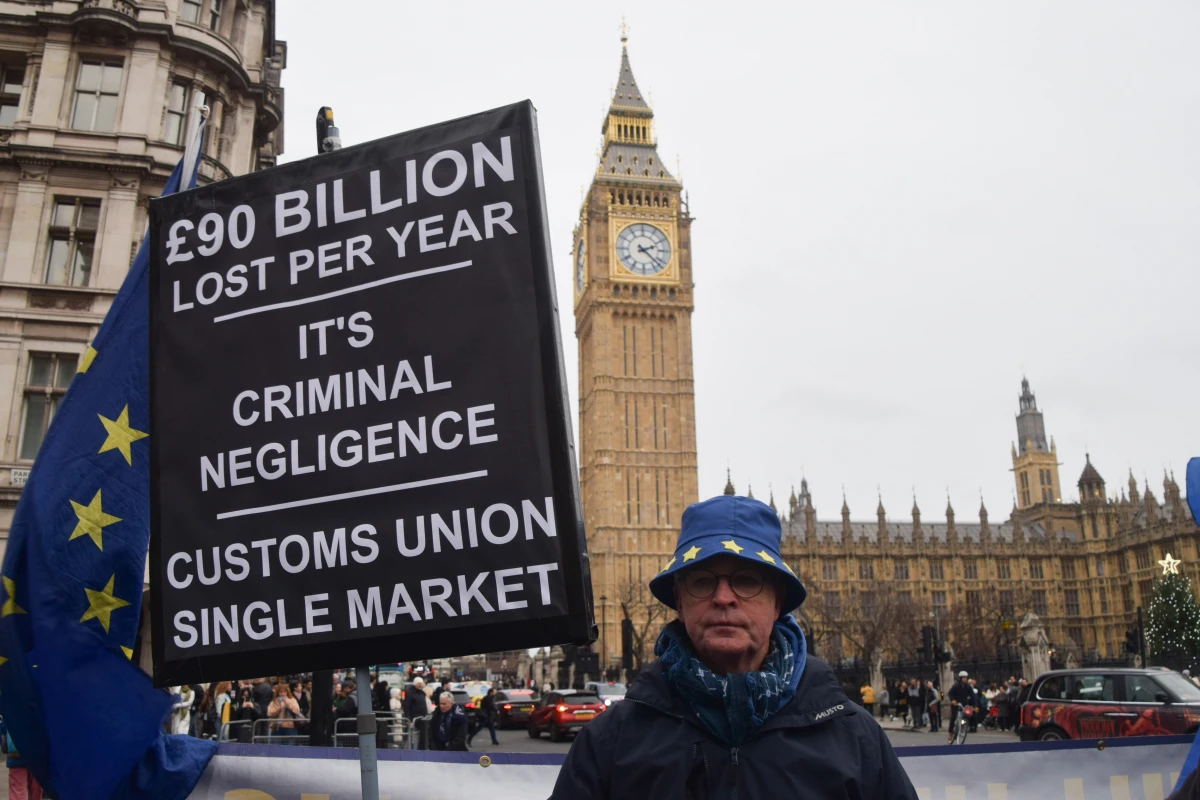
Keir Starmer's government is focused on pragmatism.
Ten years after the United Kingdom voted to leave the EU, the discussion about Brexit and its consequences is once again coming to the forefront. Economic losses, changing political sentiments, and new geopolitical challenges are prompting London to rethink its relationship with the European Union. How much did Brexit cost, and is a partial 'return' of Britain to the single market possible without fully restoring EU membership?
In 2016, the UK voted to leave the European Union, and in 2020 it effectively left the EU. However, the political situation surrounding Brexit is changing, and the question of Europe may once again become central to British politics.
Prime Minister Keir Starmer, who previously avoided discussions about returning to the EU, is now expressing his commitment to the idea of 'putting Britain at the heart of Europe.'
Polls regularly show that a majority of Britons support returning to the bloc, and politicians are increasingly openly discussing restoring ties across the English Channel.
What is the real economic price that the UK has paid for Brexit in the 10 years since voting to leave the EU? Forbes Ukraine highlights the key points from an analysis by Bloomberg.
Brexit in Numbers: GDP Losses and Changing Sentiments
Brexit may have already cost the British economy between 2% and 4% of GDP cumulatively. This is lower than previous estimates, but the central estimate of losses from Bloomberg Economics is 2.5% of GDP, which equates to about £30 billion in lost annual tax revenues, according to Bloomberg Economics. To put this into perspective, this amount would be enough to cover all capital expenditures of the Ministry of Defense.
However, there are other estimates. Economist and Brexit supporter Graham Gudgin assessed the losses at 1% of GDP, while the Bank of England estimated them at 3.5%. In contrast, a study by the NBER showed a range of losses from 6% to 8% of GDP.
The economic consequences have affected growth rates. Since Brexit, GDP per capita has grown by only 5.5%—a quarter of the British growth rates before the current financial crisis. From 2000 to 2016, the UK economy grew faster than the economies of France, Italy, and Spain, but after 2016, growth was half as fast.
Public opinion has also changed. In May 2026, 52% of Britons believed it was necessary to return to the EU, and only 33% would vote to remain outside the bloc if a referendum were held again, according to an Ipsos poll.
For example, Everything Dinosaur, a company from Cheshire, lost some sales in Europe after Brexit. Co-owner Mike Wally, who voted against leaving the EU, is outraged by the new European rules. "When we were the second-largest member of the EU, we had a voice, and now we just accept their rules and regulations," he told Bloomberg.
His business partner Sue Judd, who voted for Brexit in 2016, has changed her mind. "It's not very good for business. There are many more costs and paperwork. If the referendum were held again, I would probably vote differently," she said.
Three Scenarios for Economic Closer Ties Between Britain and the EU
There are three potential scenarios for deepening economic ties between Britain and Europe, from the most effective to the least significant:
-
Returning to the single market for goods. This would give the greatest boost to the economy. This idea was recently proposed by British officials but was rejected by the Europeans.
-
An individual package of interconnected trade agreements. This format resembles the current model of cooperation between the EU and Switzerland. Last month, British officials promoted legislation that could be seen as a step towards such an agreement.
-
Returning to the EU Customs Union. This scenario would have the least economic impact among the three but would mean a clear commitment to tariff-free trade with the European bloc.
None of these scenarios provides for the automatic opening of borders. The 'red line' for the British government remains the restoration of freedom of movement, as there is a trend of negative attitudes towards immigration, which fuels right-wing populist parties like Nigel Farage's Reform UK.
Implementing any scenario would require lengthy negotiations and concessions: Britain would have to accept European rules without a vote in their creation, resume payments to the bloc's budget, and agree to new migration terms.
At the same time, their implementation could restore between 0.4 to 1.2 percentage points of lost GDP and bring between £5 billion to £14.4 billion to the budget annually.
"Something is changing in Brexit politics. It seems that Keir Starmer's government is prioritizing economic benefits over potential pitfalls associated with the need to comply with rules," notes Anand Menon, director of the UK In A Changing Europe think tank.
Drivers and Obstacles to Closer Ties Between Britain and the EU
The need for closer ties with Europe is driven not only by economics but also by geopolitics. Russia's full-scale invasion of Ukraine and the return of Donald Trump to the White House have led the UK and Europe to feel a greater threat from Russia and less confidence in American support.
However, the reboot of relations faces the EU's reluctance to allow third countries to pick only the best membership options. The European Union does not want to allow Britain to join the single market for goods while maintaining regulatory independence for its profitable financial services sector.
The current French government is cautious about potential concessions to Britain. A key concern is that a candidate from Marine Le Pen's party, if victorious in the 2027 presidential elections, could use this to undermine the EU structure.
In contrast, Germany, the Scandinavian countries, and Eastern Europe are interested in closer ties with Britain to form a stronger deterrent against Russia.
"Foreign policy will ultimately make the EU favorable to British proposals. The common threat from the US and Russia has changed the reasons for rapprochement. Security now matters more than the single market," emphasizes Jeromin Zettelmeyer, director of the European think tank Bruegel.
However, despite the growing consensus regarding the negative consequences of Brexit, some economists hold alternative views. For instance, Brexit supporter and former chief economist at Capital Economics Julian Jessop suggests not rushing back.
"It would be madness to say that Brexit has no negative impact. It does, through trade and investment. But over the years, the positive aspects will accumulate, and the situation will start to improve. We must stop drifting back into Europe, which would bind us to all the rules and norms of the EU," he says.









Leave a comment