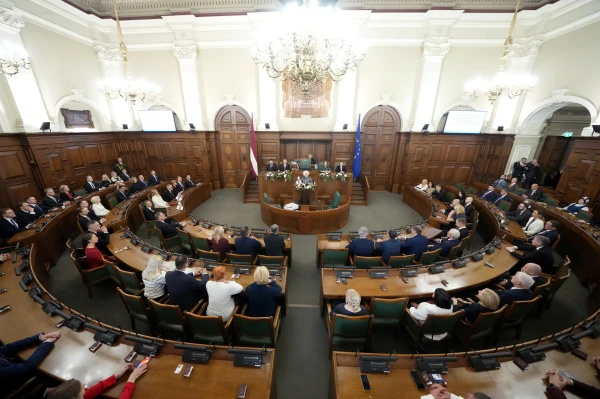
The head of the largest law enforcement agency, Rihards Kozlovskis ("New Unity"), reported to the government last Tuesday on the implementation of the program to eradicate crimes against children – and those offenses committed by minors themselves.
Cops Go to Schools
First of all, the physical presence of law enforcement officers is ensured. The "School Safety" program is being implemented, under which educational institutions will compete for the "Safe School" sign. "Safety ambassadors" in uniform and without will become regular guests for students and teachers.
The Ministry of the Interior is keeping up with the times: the function of "internet police" has been introduced in Latvia. Specialists working with children will receive software that allows them to determine whether a child has become a victim of online harassment. Schoolchildren are provided with a "self-help tool" in the event of online sexual harassment. Overall, four main programs are being implemented across Latvia:
-
To promote a safe environment in educational institutions. To increase awareness and knowledge among children, specialists, and law enforcement representatives.
-
To improve work with juvenile offenders. To reduce antisocial behavior traits and criminal relationships of offenders/convicts.
-
To enhance the identification of children who have suffered from criminal acts, help victims assert their rights, and promote social recovery.
-
To strengthen inter-agency cooperation.
In safety lessons, schoolchildren are taught the correct response to smoke detector activations, informed about water safety rules, and how not to get lost in the woods.
Are We Living in the Best of Worlds?
Here I will allow a bit of personal experience. In his book "The Better Angels of Our Nature: Why Violence Has Declined," Canadian-American scholar Steven Pinker argues that people's propensity for aggression is decreasing both in the long term and in the short term. In particular, he examines in detail the "culture of honor" characteristic of the Southern United States, where it is traditionally accepted to resolve interpersonal conflicts through violence, without much recourse to the law.
In turn, while getting acquainted with this outstanding work, your author recalled his adolescence in a late Soviet school, where fights during breaks and after classes were commonplace, and everyone knew what established the authority of Kuli, Komariks, and Barsiks; how mass brawls occurred from neighborhood to neighborhood at the railway crossing; and that complaining to teachers and especially to cops was considered disgraceful. The series "The Word of the Boy" was quite close to what was happening in the schools of Riga's neighborhoods in the 1980s. Of course, without such tragic consequences – but the general direction of group delinquency was similar.
However, after going through two full cycles of schooling for my sons in high school, I did not notice anything like that. My older son once came home from school with bruised knuckles – but not with a broken nose or lip. And the parents were not called, so everything resolved itself. The younger one somehow completely avoided this topic, probably due to his constant involvement in sports – first judo, then basketball. There were, of course, indirect signs that not everything was going well in his relationships with Latvian teammates. In any case, it did not even reach the trendy word "bullying". Maybe the scholars are right, and the world has become kinder?
But what cannot be agreed upon with Mr. Pinker is the fundamental change in human nature. We essentially remain the same beings as we were 100, 1000, and 10,000 years ago. The positivist hopes of the mentioned study (from 2011) do not align with the realities of today's nightmarish war in Eastern Europe, which is being waged by the same yesterday's and the day before yesterday's schoolchildren. And it is not just one aggressor state that is to blame here – the mass crimes against civilians and prisoners of war, the senseless destruction of cities and the annihilation of nature, are all perpetrated by specific individuals. On both sides of the front, in this regard, both warring camps are the same...
Digital Control Instead of Special Schools
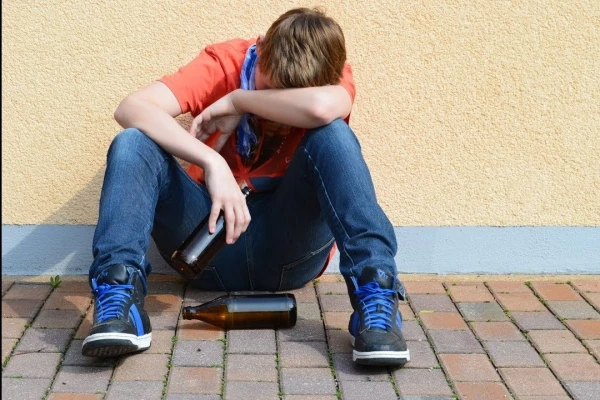
Whatever is said now about the hypocrisy of Soviet upbringing – the fact remains, alcoholism and especially drug addiction among minors were considered emergencies back then. Now, however, this is quite a commonplace practice for the same Emergency Medical Service.
Therefore, the issue of sobering centers for minors has arisen in Latvia. The Ministry of the Interior calls for: "To ensure inter-agency discussions to assess the possibilities of creating a service for delivering children under the influence of intoxicating substances to a safe environment and further rehabilitation."
At the same time, law enforcement officers propose to reconsider the regulation of the Law on the Application of Compulsory Educational Measures to Children and the Law on the Protection of Children's Rights regarding the prevention of offenses, "evaluating the possibilities of abolishing administrative punishment for children and placing children in educational institutions for social correction."
In these very special institutions, law enforcement has not succeeded – particularly regarding the "creation of a digital learning environment in places of detention." After all, the "Road of Change" program was supposed to be created not only in the Cesis juvenile colony (where individuals up to 25 years old are actually held), but also in the Liepaja and Daugavgriva (Daugavpils) prisons, where young detainees serve sentences after turning 18.
Now, there are plans to improve the inmate information system (IIS) to ensure filtering, selection, and loading of data on juvenile recidivism. Theoretically, of course, it is possible to keep almost every troubled youth under surveillance using big data systems.
However, upon studying the Ministry of the Interior's document, we end up with completely laughable amounts that are supposed to be spent on all this – 153,000 euros. This is not even a percentage, but a fraction of a percentage of what Latvia spends on military needs in a year. Although, a potential aggressor is a somewhat abstract entity, our "bad guys" are always among us...