
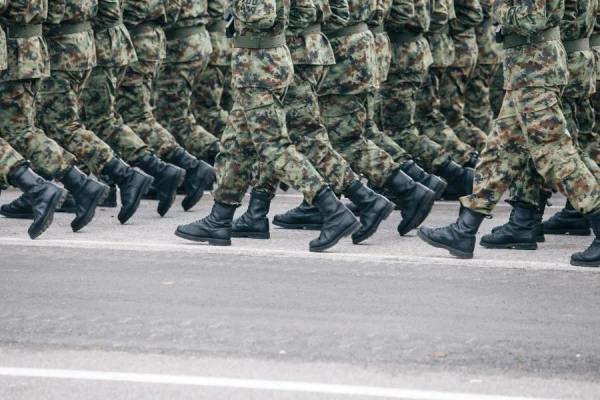
Soon, a newly developed Law on the Defense and Security Fund will be submitted to the Saeima for consideration. Its co-authors – the heads of the military and financial departments – hope to "provide additional funding for the development of defense capabilities."
The portal bb.lv examined what and how in the new regulatory act.
Take and Share
The first reasonable question is – has the budget of the Ministry of Defense been canceled? Are the National Armed Forces (NAF) on a starvation diet? Not at all: it remains, but according to paragraph 1 of Article 3 of the new Law, "the financial resources of the Defense and Security Fund are planned... under a separate budget program."
In other words, beyond the already planned defense expenditures, a reserve will be created, into which, in particular, funds will be sent that "will be reallocated during the execution of the budget..." (paragraph 1, Article 3). Additionally, the military will be able to use "donations from individuals and legal entities" (paragraph 3, Article 2), "foreign financial assistance" (paragraph 4, Article 2).
What will the funds be spent on? Firstly, it is for "the development of the National Armed Forces to achieve the defense goals of the state and NATO"; then "defense industry projects..." Among these, by the way, dual-use products are expected, aimed at "ensuring economic viability." It is anticipated that the Latvian defense industry will gain "high commercialization potential."
As an incentive for the people, who are believed to contribute their money and valuables to the Fund, promises are made for "strengthening the comprehensive defense of the state by developing civil defense, crisis management systems, internal and external security, cybersecurity, and state border security." And, of course, "military support for Ukraine" is designated as an area of expenditure under the modest item 5 of Article 4.
The Fund will be inter-agency: "The Ministry of Defense, in cooperation with the Ministry of Economics, the Ministry of the Interior, the Ministry of Foreign Affairs, and the Ministry of Transport, once a year, simultaneously with the presentation of priority activities to the Ministry of Finance, submits to the Cabinet of Ministers a summary of the decisions made and proposals for the use of funds for the next three years."
Digging from Here to Lunch
The annotation attached to the draft law outlines the contours of future expenditures from the Fund in somewhat more detail: "Having established the need for additional capabilities, the Ministry of Defense, in cooperation with the National Armed Forces (NAF), has identified the areas of capabilities that need to be developed in the short and medium term.
As extremely urgent areas of defense capability and priority development, the following have been identified:
-
the creation of a combat-ready division 'North',
-
the development of a mechanized infantry brigade of the ground forces,
-
air defense,
-
the development of allied forces and combat support capabilities."
According to the needs of the NAF, the document from the Ministry of Defense notes that in the medium term, at least 5% of the gross domestic product is necessary. For comparison, the current expenditures of the Ministry of Defense amount to 3.68% of GDP.
However, the aforementioned criteria do not withstand criticism when viewed from the perspective of the practical application of forces and means in the Russian-Ukrainian war:
-
Neither side uses divisions; at most, brigade or battalion tactical groups are employed, and most often soldiers operate in small groups using special operations tactics;
-
Armored vehicles in the form of tanks and infantry fighting vehicles on both sides of the front have mostly been withdrawn to the rear, as they become easy prey for drones that cost hundreds of times less than vulnerable 'boxes';
-
Classic air defense forces with supersonic missiles are powerless against drones with motorcycle engines, which are shot down with hunting rifles or other drones.
In other words, Latvian military minds are proposing to prepare for yesterday's conflict – keeping in mind the powerful armored wedges of the enemy that must be met with an indestructible defense, wear them down, and deliver a counterstrike. But even if the worst scenario of military confrontation for the Baltics happens – the example of Ukraine shows that today different laws prevail on the battlefield...
Instead of Shelters for Residents – Protected Embassies
If the enemy is so cunning and treacherous, it would be logical to create a national system of shelters for the population. However, the annotation outlines somewhat different priorities:
"The work covers, for example, manifestations of hybrid threats, including disinformation, political pressure (sanctions), as well as the military presence of allies in Latvia. Considering the role of the foreign service in a crisis situation, both in providing support to allies and maintaining contact with Latvian state officials abroad, it is important to promote the resilience of the foreign policy agency. The premises of the Ministry of Foreign Affairs and diplomatic and consular representations are a tool for implementing the tasks set out in the government declaration and the functions of the Ministry of Foreign Affairs approved by the Cabinet of Ministers, including when dealing with issues essential for strengthening national security."
How beautifully they twisted that! Translating from bureaucratic to human: with the money from the Fund, the embassies of Latvia abroad will be refurbished, and for the common people, the queue will come later – just wait...
Starting from 2026
Now let’s see what this will mean for the treasury of the homeland. Starting next year, additional expenditures for the Fund are fixed in the "Budget Expenditures" section. Or "changes compared to the medium-term budget framework." So:
-
2026 – 424,479,977 euros;
-
2027 – 497,000,000 euros;
-
2028 – 716,800,000 euros.
In total, 1,638,279,977 euros are planned to be withdrawn from the economy and social programs over three years.
Everything is straightforward and cynical, and not particularly hidden: "Directly or indirectly, the draft law affects all target groups of society, as it concerns the use of public financial resources to achieve the goals of defense and security of the state. Given the urgency of the draft law, its impact on the specified area was not assessed."
The main problem with this approach is that the defensive functions, should the need arise, will have to be performed not by numbers in an Excel table, but by specific people. What are called – cogs. But will they have motivation for the notorious "comprehensive defense" when by that time the state has become completely impoverished? After all, as Marshal of Finland Gustaf Emil Mannerheim said: "Indeed, the common man sees further and earlier – than both the government and the parliament."










Leave a comment