
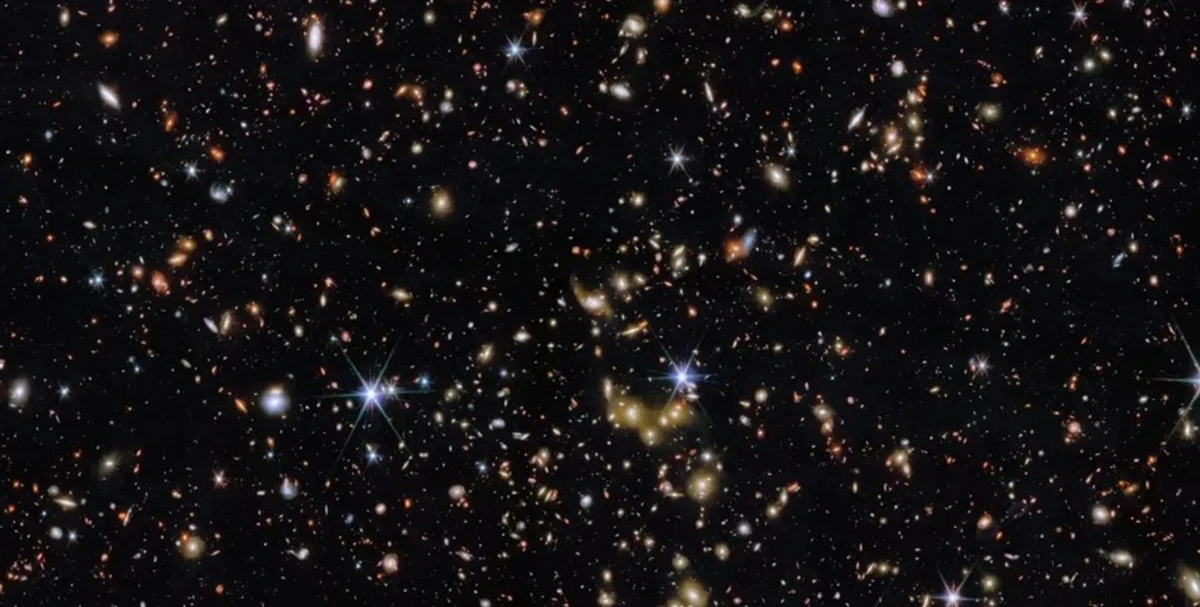
Galaxies may eventually stop rotating, but it is unexpected at such an early stage in the history of the universe.
Rotation is one of the most important characteristics of galaxies. However, not all galaxies rotate. Multiple collisions and interactions with other galaxies can strip these cosmic objects of their angular momentum. This process is believed to take billions of years. Therefore, astronomers were very surprised to discover a massive galaxy that does not rotate less than 2 billion years after the Big Bang, writes Focus.
XMM-VID1-2075 was already known as one of the most massive galaxies in the early universe. It has several times more stars than the Milky Way. Also, no new star formation is occurring in this galaxy, as previous observations have shown. The authors of the new study decided to use the Webb Space Telescope to study the motion of the galaxy XMM-VID1-2075 and two other galaxies from the early universe.
According to the scientists, it was unexpected for them that the galaxy XMM-VID1-2075 does not rotate, although it should.
The three galaxies, while similar, exhibit completely different internal dynamics. One of them clearly rotates, another appears somewhat chaotic, while XMM-VID1-2075 shows no rotation but demonstrates very chaotic internal movements of its stars.
The size of the galaxy, the lack of star formation, and rotation may be the result of the same mechanism. Instead of several small collisions that slowed the galaxy down, a single merger with a galaxy that was rotating almost in the opposite direction occurred, astronomers believe.
There is supporting evidence for this hypothesis. Astronomers have detected a large source of light, likely another galaxy, that is interacting with XMM-VID1-2075 and changing the dynamics of this galaxy.
Although this is an astonishing discovery, it is unlikely that this galaxy is an exception to the rule. Astronomers believe that there may be many galaxies that do not rotate in the early stages of the universe's history.
The authors of the study say that existing models predict that there were a small number of galaxies that did not rotate in the early stages of the universe's existence. If a large number of such galaxies are discovered, the theory of the universe's evolution will need to be reconsidered.














Leave a comment