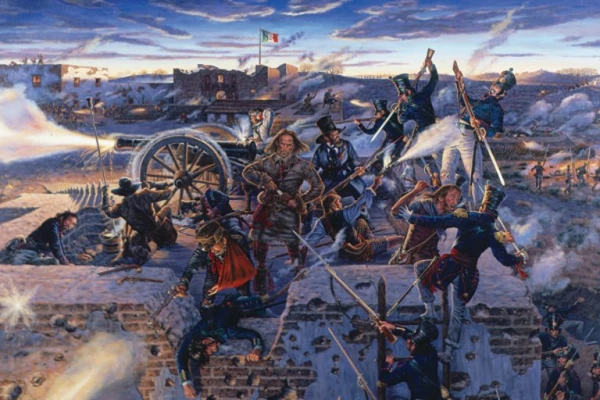
The Alamo fortress, originally built in 1718 as a Spanish mission, became a key battleground of the Texas Revolution.
At the site of the historic Alamo fortress in the US, archaeologists made a rare discovery: during excavations, a completely intact bronze cannonball dating back to the period of the famous siege of 1836 was found. The artifact was unearthed just one day before the 190th anniversary of the battle between Mexican troops and Texas rebels.
According to the team from the preserve, the find made a strong impression on specialists. Tiffany Lindley, head of the Alamo archaeological department, noted that seeing such well-preserved ammunition nearly two hundred years old is a great rarity and a significant emotional event for researchers.
The Alamo fortress, originally built in 1718 as a Spanish mission, became a key battleground of the Texas Revolution. During the 12-day siege, the Mexican army commanded by General Antonio López de Santa Anna surrounded the fortification, which was defended by about 180 Texas rebels led by William Travis, James Bowie, and Davy Crockett. The assault, which began on March 6, 1836, ended with the complete destruction of the garrison, and the slogan "Remember the Alamo!" later became a symbol of the struggle for Texas independence.
The discovered cannonball was found in the area of the northeast corner of the church—part of the former Spanish mission—at a depth of about 0.9 meters. Senior researcher at the Alamo, Colby Lanham, reported that the item is a bronze projectile weighing about 1.8 kilograms.
According to him, such ammunition was actively used by the Mexican army, while the Texas defenders of the fortress more frequently employed iron balls. This allows for a high degree of confidence in attributing the find to the armament of the Mexican troops and linking it both to the assault itself and to the shelling during the 12-day siege.
In addition to the intact projectile, archaeologists extracted four fragments of cannonballs from the ground, likely fired from a howitzer—a short-barreled cannon. Specialists are currently attempting to reconstruct these munitions by connecting the individual parts.
Archaeological work at the Alamo continues, and each new discovery helps clarify details of the battle's course and daily life in the fortress. According to Lanham, such finds not only complement the historical picture but also literally "bring to life" events nearly two centuries ago. The bronze cannonball, which lay in the ground for about 190 years, is now becoming an important material part of the story of the defense of the Alamo.