
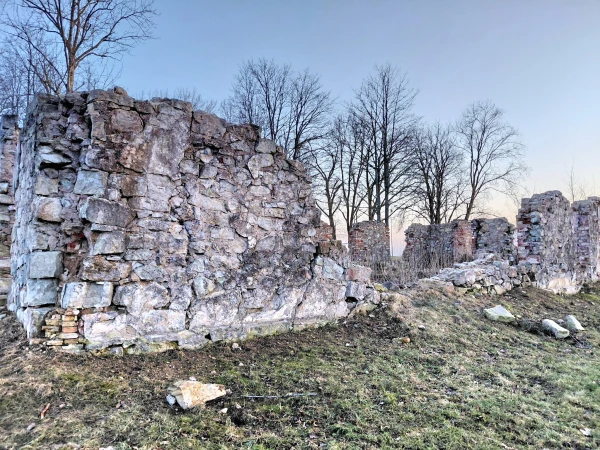
Next to the Kengarags residential area — secrets from the 13th century!
Rumbas Street is quite long by Riga standards — about 900 meters, stretching from Latgales (formerly Maskavas) to the banks of the Daugava, with a notable landmark being the infamous supermarket that starts with an unfortunate letter Z. But Rumbas iela is unfortunate — there is no permanent population here.
On the right, there is a small forest, on the left, there are dumps of old cars, and as for the pavement... Consider that it is non-existent. The mud, interspersed with craters, creates such an outstanding landscape that even my vigilant car navigator warns: “Something terrible ahead!”
Although, in a way, this is for the best – outsiders do not walk here. On a pleasant spring evening, there are only a few cars, and people stroll along the freshly paved promenade that now stretches for kilometers along the banks of the Daugava. Someone is walking their dog. It’s a great spot for barbecues on the hill, where you can watch the sunset over the Dvina. A place, in the literal sense, prayed over.
Where Did the Jesuits Bury Their Treasures?
The history of the Jungfernhof estate (Virgin Manor), or, according to modern toponymy, Mazjumprava, began at least in 1259, when the land here was granted to the nuns of the Cistercian monastery of St. Jacob. Peasants from those Baltic tribes, who were not allowed into medieval Riga, settled here. They prayed to the Lord and supplied eco-friendly products to the city dwellers. The second name became Blumenthal — Flower Valley.
Time passed, and by the end of the 1500s, the prosperous estate was acquired by the Jesuits of Riga. The reign of Polish, Catholic kings was at hand. The strong managers annexed a vast territory to Jungfernhof up to Kisezers, as well as lands in the hinterland – all the way to Tornakalns.
But just forty years later, the Lutheran Swedes captured Livonia, and the Jesuits left it (most likely hoping to return – and surely buried a lot of treasures!). In 1627, Gustav II Adolf granted the estate to the master of the Riga Mint, Martin Wulf. After his death in 1633, the Mazjumprava estate was sold to the city of Riga in 1636 for seven thousand silver dalder (by the way, the word dollar comes from this!), and in 1637 the purchase was approved by the Swedish king.

The mill pond in all its glory. Photo by the author.
Transitional Property
But geopolitics intervened again in the rural idyll. In early spring 1700, near Jungfernhof, the combined forces of the Duchy of Saxony and Courland crossed the Daugava – and began the siege of Riga. In fact, the Germans, allies of Peter I, were attacking the Germans who were already under the patronage of Stockholm.
On May 6 (17), a fierce battle occurred near Mazjumprava, in which the Swedes defeated the Saxons – forcing them to leave the right bank of the Daugava. But this operational success only delayed the inevitable collapse of the Swedes in the Great Northern War. The scales were not in their favor!
At the beginning of the 18th century, the owner of the estate was the senior vogt Pauls Brockhuzens. The term “vogt” referred to an official in the German lands who acted as an administrator, judge, or manager of church and monastic lands. The position often became hereditary, and the vogts concentrated real power in their hands, collecting taxes and administering justice. And when Russian troops were stationed on the estate during the siege of Riga in 1709, Brockhuzens did not allow the lord's house of the estate to be used, ordering Peter Alekseevich's officers to settle with the peasants. For this humiliation, in 1716, Brockhuzens himself was exiled to Siberia.
But the estate continued to be managed by the sons of Brockhuzens. The younger son – Georg Brockhuzens – was notorious for his stinginess and cruelty. When the feudal lord acquired the estate of Dunte, windows and doors were ripped out of the manor on the Dvina, pipes and stoves were dismantled, and everything was transported to his new estate. Even fruit trees were uprooted with all their roots to be transplanted in Dunte. Later, after numerous complaints from the ruined peasants, the inspection concluded that the Brockhuzens had devastated the estate, exhausting the land.

Jungfernhof as depicted by the master Broce.
More Than a Thousand Serfs
After Georg Brockhuzens' death in 1752, the estate was taken over by the city of Riga. Around 1777, the Olain estate was separated from the estate with Plakanciems. The scale can be assessed by knowing that in 1797, 3,357 people lived on the estate's lands, including 1,132 serfs and 1,170 people who came from other regions. In 1799, the Dreilins estate was created on the side of Lake Juglas.
In the late 18th century, the Jumprava estate ceased to be particularly wealthy, and poor peasants lived there. By the way, the famous Baltic painter Johann Heinrich Bauman (1753-1832) also worked there. His contemporary and friend Johann Christoph Broce (1742-1823) captured the estate in his lovely engravings.

A map from the late 18th century.
When in 1877 the Riga city council leased the estate to Johann Ratfeld, the description of the contract mentions 16 buildings, including a water mill and an inn. For example, the lord's house had a tiled roof, double entrance doors, 13 windows, and 7 internal doors. Unfortunately, only small traces of that splendor remain now...
The Cruel 20th Century
During World War I, in 1915, the estate was abandoned, and in 1919, during the Bermontiade, it was completely destroyed. From 1925 to 1940, it was leased to Zhenya Shtobe. In the 1930s, a pier for river vessels was built here.
The darkest page was written in the history of Jungfernhof-Jumpravmuiža during the Nazi occupation. In December 1941, a concentration camp was established on the estate's territory of 200 hectares, where about four thousand Jews from Germany and Austria were imprisoned. The prisoners were engaged in the arrangement of the estate, in quarries by the Daugava, and in craftsmen's workshops in the vicinity of the estate. About 800 of them died from starvation, and in March 1942, 1,600-2,000 prisoners were shot in the Bikerneki forest. By 1943, only about 450 remained alive. By this time, the camp had been liquidated, but as late as September 1943, 81 Jews were registered for various work at the Mazjumprava estate.
After the war, part of the Soviet army was stationed on the estate, and the lord's building housed an outpatient clinic. The arrangement of the surroundings was carried out by the Riga City Council in 2017, and archaeological excavations have been ongoing since 2020. Now, local residents enjoy walking here with their dogs.
But still, when the sun sets in the Daugava expanse, something troubling and complex arises in the heart...











Leave a comment