Conquering territory and holding it are tasks of entirely different orders.
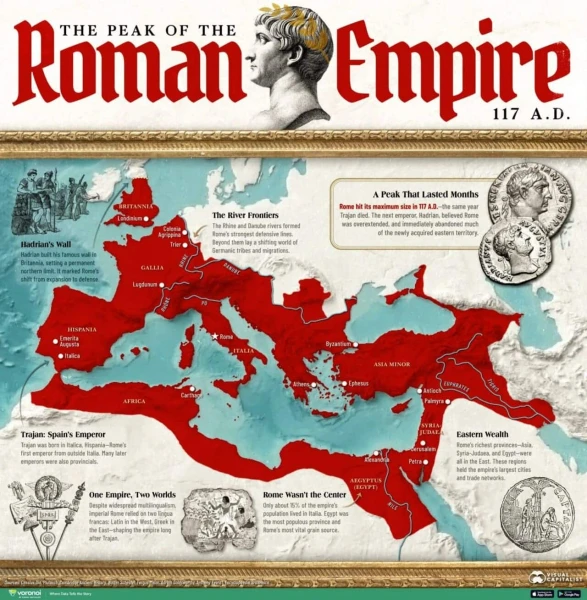
For lovers of ancient history, this map of the Roman Empire is likely to look familiar. It shows the greatest territorial extent that the Roman Empire ever reached — just after the ambitious eastern campaigns of Emperor Trajan. During these wars, he conquered Dacia, Armenia, Mesopotamia, Assyria, and captured the Parthian capital of Ctesiphon (in modern-day Iraq).
Although historians rank Trajan among the best Roman emperors and consider him one of the most outstanding military leaders in the history of Rome, the peak of power he achieved turned out to be short-lived.
Trajan was born in the city of Italica in Spain, near modern Seville. He was a professional soldier, made a career in the army, and earned a reputation as an exceptionally competent and respected commander. The childless Emperor Nerva adopted him and appointed him as his heir, and after Nerva's death in 98 AD, Trajan ascended to the throne.
As emperor, Trajan became famous for both large-scale civil projects and military expansion. He built roads, harbors, aqueducts, and the Trajan Forum in Rome — while simultaneously decisively conquering distant lands.
History shows that any empires face limits to growth — cultural, geographical, logistical, and administrative — that prevent them from expanding indefinitely.
Trajan came close to these limits and ultimately faced a breaking point. The conquest of Dacia (modern Romania) was perhaps his greatest military success and ensured Roman dominance in the region for almost two centuries. However, the eastern campaigns proved to be much less sustainable.
Wars with Parthia — the second superpower of the Mediterranean at the time — led to rapid expansion in Armenia, Mesopotamia, and Assyria. However, these vast acquisitions were extremely fragile:
-
supply lines became too stretched, vulnerable, and costly;
-
large-scale uprisings broke out in Judea and throughout the Jewish diaspora — in Libya, Egypt, and Cyprus;
The Parthian Empire, despite symbolic defeats, retained its power.
Looking back, it can be said that this map captures not only the greatest triumph of Rome but also the moment when the empire exceeded its capabilities.
Conquering territory and holding it are tasks of entirely different orders. When the troops were spread across several fronts, Trajan's new possessions began to rapidly lose stability. At the same time, having already crossed the sixty-year mark, the emperor's health began to seriously decline. On his way back to Rome, he stopped in Cilicia (in modern southern Turkey), where he passed away.
His successor Hadrian immediately realized that the empire had reached its limits and now needed not further expansion but strengthening and consolidation. He built Hadrian's Wall in Britain and abandoned most of Trajan's eastern conquests, focusing on stabilizing the state.