
English antiquity is a surefire theme.
A British miniseries has premiered on Netflix that could spark a new detective franchise based on Agatha Christie's novels, adapted to the tastes of today's audience.
In a deserted bullfighting arena, a man (Ian Glen) frantically darts around, trying to understand from which pen an enraged animal will emerge. An unseen figure opens the gates — and a bull charges, goring the unfortunate gentleman; this is not a bullfight, but a premeditated murder. The opening title informs us that this dramatic scene takes place in 1920 in the Spanish town of Ronda. Perched high in the mountains, with a majestic medieval bridge hanging over a chasm, this town could serve as a backdrop for any fantasy — the views here are so fantastical. But filmmakers seem to overlook it for some reason — so thank you to Netflix for organizing the shoot in one of the most cinematic places in the world.
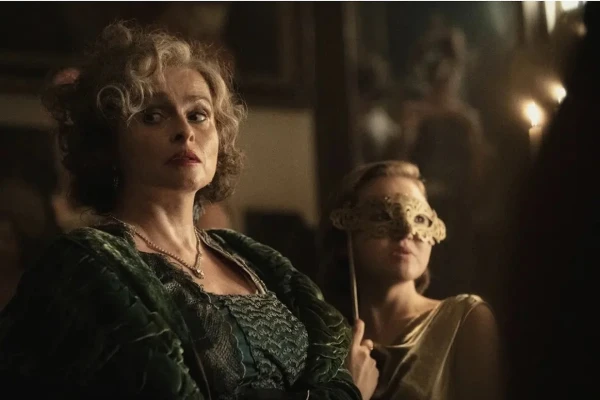
Next, the action shifts to the picturesque Badminton House — the setting for "Bridgerton" and Guy Ritchie's "Gentlemen." This time, it is the estate of impoverished aristocrats: in 1925, the widowed Lady Caterham (Helena Bonham Carter) rents out the family estate for a lavish reception hosted by a steel magnate. This nouveau riche, hoping to secure a lucrative government contract, gathers high society, including many officials from the Foreign Office. But trouble arises — the next morning, young Foreign Office clerk Jerry Wade (Cory Milcrost) is found dead in his bedroom. The young man died from an overdose of sleeping pills, and the police quickly close the case, deeming the death a suicide.
Lady Caterham's daughter, the clever Lady Aileen Brent (Mia McKenna-Bruce), known to friends and family as Bundle, does not agree with this verdict. She has every reason to doubt Wade's suicide: they had romantic feelings for each other, and Jerry was about to propose to her — why would he end his life on the brink of happiness? Bundle's suspicions turn into certainty when another young clerk from the ministry is found shot, having whispered something to her before dying about the "mystery of the seven dials": in the poisoned Wade's bedroom, the killer lined up seven alarm clocks on the mantelpiece. At the same time, there is a district and a nightclub in London called "Seven Dials" — upon visiting, Bundle realizes she is being followed and encounters the mysterious Inspector Battle (Martin Freeman) from Scotland Yard, who is also interested in the case. In a race against the inspector, Bundle must uncover who placed the seven alarm clocks on the mantelpiece, what steel casting has to do with it, and why a pale Englishman was killed five years ago in the bullfighting arena.
Agatha Christie wrote five detective novels featuring Superintendent Battle, but unlike the stories about Poirot and Miss Marple, they have remained on the sidelines of her work. Battle's adventures are much less known, meaning the detective intrigue will be new to today's viewers — unlike the endlessly adapted "Ten Little Niggers" or "Murder on the Orient Express." For Netflix, the plot was adapted by renowned British screenwriter Chris Chibnall ("Doctor Who," "Life on Mars," "Murder on the Beach") — and almost everything Netflix touches becomes the foundation for a franchise.
Diverse Englishness sells particularly well — Victorian, hooligan, Windsor, cozy retro in checks, football dramas in stripes, and of course, classic detective stories. Hollywood has put Englishness on a conveyor belt and tailors it to its schemes, but the genuine British identity and specific absurdist humor in such stories are diminishing, while clichés are increasing; everything is subject to unification and is adapted to the tastes of the audience, in the view of streaming platform producers — quite unpretentious.
At the time, critics received "The Mystery of the Seven Dials" (1929) — Christie's second novel featuring Superintendent Battle — with coolness. They criticized its implausible and overloaded plot: it features a dreadfully romantic secret society, the theft of military inventions, spies and police, and bankrupt aristocrats — a contrived intrigue instead of the previous carefully constructed and grounded detective schemes. But the current adaptation only needs that: the more fantastic the plot and the more it resembles a comic, soaring above logic by its own laws, the better. It has turned out to be a sort of "Agatha Christie for Zoomers" — with postcard views for travel enthusiasts, a spy intrigue in the spirit of "Kingsman," and a young detective Bundle, who has pushed the mossy inspector into the background in the spirit of "Enola Holmes." Firstly, it is beautiful. Secondly, a sequel can be made.















Leave a comment