
The famous architect was born around the 80s–70s BC.
Italian archaeologists have seemingly discovered the ruins of the only basilica designed by the famous ancient Roman architect Vitruvius. The remains of the structure were excavated under the square of the city of Fano, which is located on the Adriatic coast of the Apennine Peninsula. This was reported by the Italian Ministry of Culture.
Vitruvius Marcus Pollio (or simply Vitruvius) is perhaps the most famous ancient Roman architect and engineer, whose theoretical work had a significant impact on architects and thinkers during the Renaissance. Not much is known about Vitruvius himself – our knowledge is mainly based on autobiographical information presented in his fundamental work "Ten Books on Architecture."
The future architect was born around the 80s–70s BC. After receiving an education, he joined the army and, in particular, served during the civil war that lasted from 49 to 45 BC, when the army was commanded by Julius Caesar himself. Apparently, during his service, Vitruvius was involved in the development, maintenance, and repair of military machines, and after leaving the army, he composed his famous work, in which he focused primarily on the art of construction. However, as far as researchers know, Vitruvius designed only one major building by himself – the basilica in the Julian colony of Fano (Julia Fanestris), which is now the Italian resort city of Fano in the Marche region.
Researchers have long sought to find the ruins of this basilica, which was destroyed along with the city during the Gothic invasion in 540 AD. In particular, in 2023, when archaeologists in Fano discovered the remains of a large and luxurious Roman-era building located near the ancient forum, they hypothesized that it might represent the very structure of Vitruvius, erected around 19 BC.
However, as time showed, this hypothesis was incorrect, and the true ruins were found only recently.
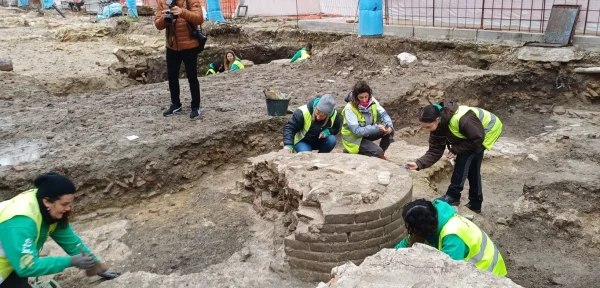
During reconstruction work in Andrea Costa Square in the city of Fano, archaeologists conducted excavations and found the remains of a large structure. According to researchers, it precisely matches the building that Vitruvius described in Book V of his work "Ten Books on Architecture." This led archaeologists to conclude that the discovered building is likely the long-sought basilica built in the 1st century BC. It was a rectangular structure with many columns, each about one and a half meters in diameter and approximately five meters in height.
In pre-Roman times, the Marche region was inhabited by a now-extinct people – the Picenes. Geneticists analyzed the DNA of more than 50 representatives of this community who lived in the 1st millennium BC a couple of years ago and found that the majority of the ancestors of these people came from populations that existed on the Apennine Peninsula as far back as the Bronze Age.















Leave a comment