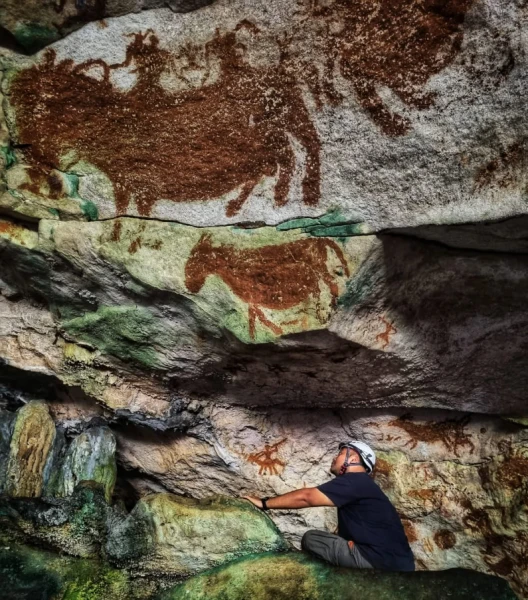
As companions, people brought wild pigs to the islands.
On an island near Sulawesi (Indonesia), traces of the first wave of successful migrants from Africa have been found. Just a few thousand years after that migration, they were already painting on the walls of caves that could only be accessed via the open sea. New data means that anthropologists will have to significantly reconsider the capabilities of ancient people.
An international group of scientists investigated 44 caves in the southern part of the Indonesian province of Sulawesi, 14 of which were previously unknown. In one of them, they found traces of paint applied around human palms. Despite the stenciled simplicity, these images are the oldest of all known examples of rock art. The results of the work were published in the journal Nature.
The authors of the study applied high-precision uranium-thorium dating of the layer of calcium carbonate that covers the images in the Liang Metanduno area on the island of Muna (southeast of Sulawesi). The layer is dated to 71.6 ± 3.8 thousand years. This indicates a minimum age of the image of 67.8 ± 3.8 thousand years.
This date is 16.6 thousand years older than the earliest known rock images in this part of the world. Even the oldest rock images in Europe are 1.1 thousand years younger. Currently, Neanderthals are considered the authors of the earliest images in Europe. Scientists also reminded that European datings are disputed (however, in archaeology, most truly unusual datings are contested).
The researchers concluded that they found the oldest known example of rock art. They stated that it is impossible to reliably understand which species left these images. Moreover, early species colonized the territory of modern Indonesia at least a million years ago.
Still, they consider the authors to be people of our species, as more archaic species are deemed incapable of leaving such images. However, it should be noted that similar claims were once made about Neanderthals.
The work partially clarifies and partially complicates the picture of human history in that era. Anthropologists had previously concluded that after leaving Africa about 70,000 years ago, modern humans quickly reached Australia (around 65.0 ± 3.7 thousand years ago).
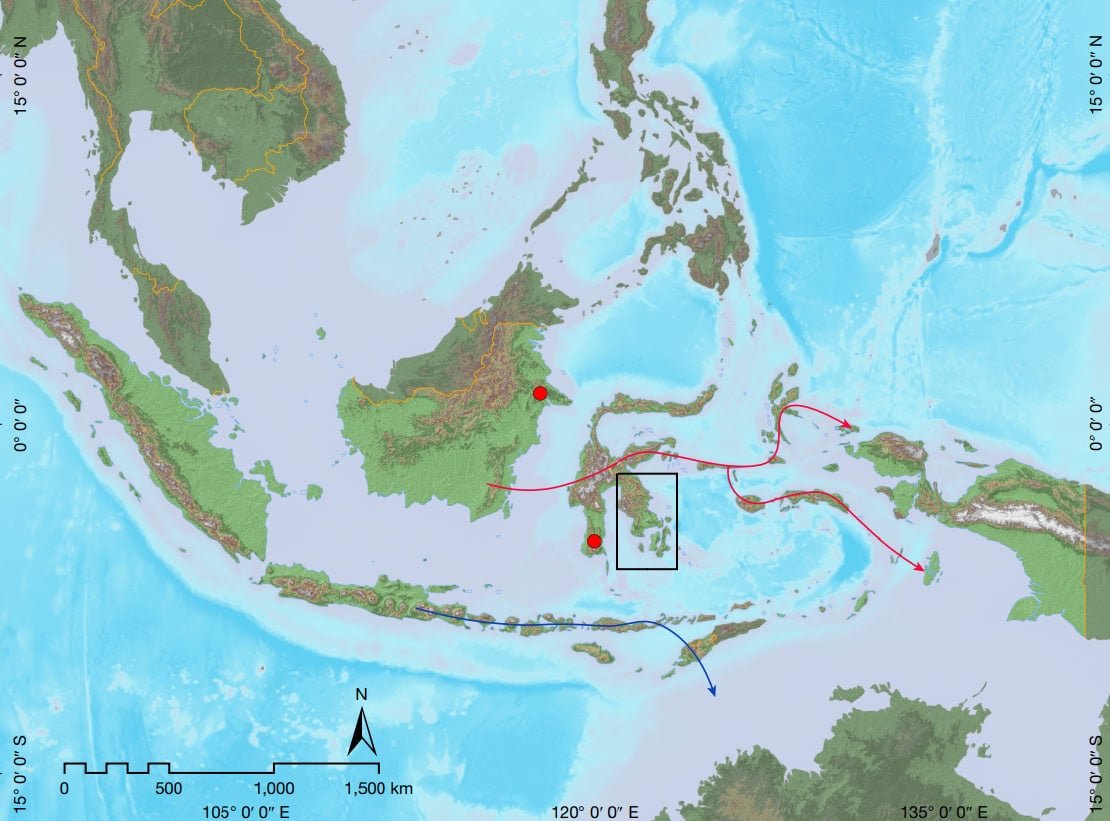
But the route they took to cross the sea in their path was unclear, as there were no findings of human traces between the continent and Australia and New Guinea (then part of the Sahul continent).
Two hypotheses were proposed: in the south, people traveled by sea to Timor, and from there to Sahul. In the north, they traveled through the Sulawesi region and its surrounding islands. Until now, there had been no archaeological evidence of the northern colonization route around 70,000 years ago. The new images became the first such evidence.
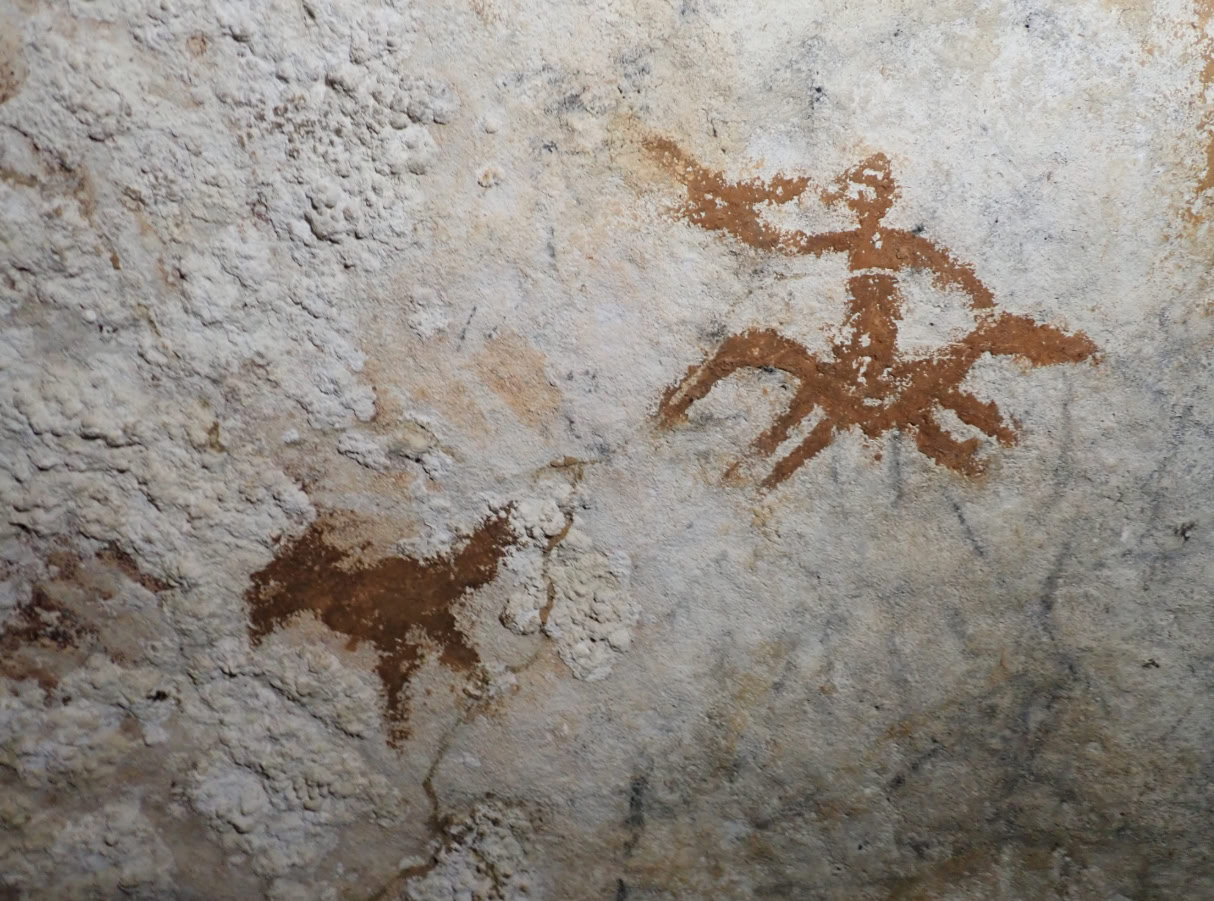
At the same time, in some ways, the picture has become more complicated. It is difficult to exclude the possibility that migrations occurred along both routes. Overall, our understanding of Paleolithic people, their flexibility, and capabilities has changed significantly in recent years. It has become known that people brought wild pigs to the Sunda Islands tens of thousands of years ago — without agriculture, simply to have something to hunt. Those who colonized Australia even exported wild kangaroos from it to islands a hundred kilometers from the continent, apparently for the same purposes of breeding for hunting. People who can transport sizable mammals across open seas are quite capable of crossing it via various routes.
<iframe width="560" height="315" src="https://www.youtube.com/embed/2yO-OM6B3dQ?si=QgXS5r-G6EkIppo1" title="YouTube video player" frameborder="0" allow="accelerometer; autoplay; clipboard-write; encrypted-media; gyroscope; picture-in-picture; web-share" referrerpolicy="strict-origin-when-cross-origin" allowfullscreen></iframe>