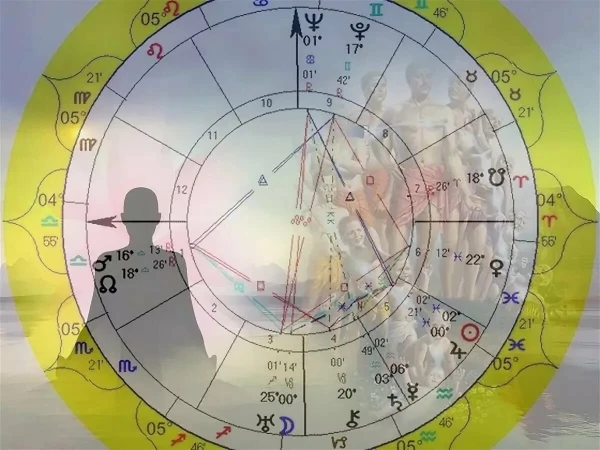
The natal chart plays a key role in astrology as it is considered a reflection of an individual's characteristics and life path. It is not just a horoscope, but a detailed diagram based on precise birth data, used for in-depth analysis of personality, potential, and important life themes.
What the Natal Chart Represents
The natal chart is an astrological diagram of the moment of a person's birth. It displays the positions of planets, luminaries, and other astrological points relative to the earthly horizon at a specific time and place. All elements of the chart are represented as symbols and form a holistic picture of the interaction of cosmic energies at the moment of a person's emergence into the world.
To construct the chart, an astrologer needs the date, place, and as accurate a time of birth as possible. Time is considered the most critical parameter, as even a small error can change the positions of houses and the ascendant, thus distorting the interpretation.
From an astrological perspective, every moment is unique, which is why each person's natal chart is one of a kind. The more accurate the initial data, the deeper and more detailed the individual character traits and life scenarios can be revealed.
How to Start Reading the Natal Chart
Elements and Temperament
The first stage of analysis is determining the predominant and weak elements: fire, earth, air, and water. These elements shape the basic temperament of a person and set the overall emotional and psychological background of the personality.
Elements can be compared to the background of a painting, on which details—planets, signs, and aspects—will later be drawn.
Sun, Moon, and Ascendant
After determining the general background, we move on to the key elements of the chart:
- Sun — the core of the personality, life energy, and main purpose of incarnation. It shows what a person lives for and what they strive to realize.
- Moon — the inner world, emotions, needs, and sense of security. It is responsible for psychological adaptation and reactions to what is happening.
- Ascendant — the external manifestation of the personality, physical appearance, and how a person is perceived by others. It also indicates the earthly and social tasks of the soul.
Detailing Through Personal Planets
At the next stage, the analysis is supplemented by personal planets, each of which is responsible for specific functions:
- Mercury — thinking, learning, communication, logic, and working with information.
- Venus — love, feelings, aesthetics, finances, pleasure, and creativity.
- Mars — energy of action, initiative, the ability to stand up for oneself and handle conflicts.
It is important to consider not only the positions of the planets in signs but also the aspects between them. Aspects can enhance or, conversely, soften the manifestation of planetary qualities.
Weak and Tense Areas of the Chart
Almost every natal chart contains problematic points. These include afflicted planets, tense aspects, and challenging houses. They indicate internal conflicts, life difficulties, and tasks that a person will need to work through.
Problematic areas are indicated if the planets:
- have a predominance of tense aspects;
- are in signs of fall or exile;
- are burned by the Sun;
- are associated with Lilith or unfavorable stars.
Event Level and Houses of the Horoscope
Specific life events are represented by the houses of the natal chart. Each house symbolizes a particular sphere of life and shows where key events will unfold.
For correct interpretation, the following are considered:
- the ruler of the house;
- the sign on the cusp;
- planets located within the house.
In astrology, it is commonly accepted that:
- finances — Venus, 2nd and 8th houses;
- career — Jupiter, Saturn, 6th and 10th houses;
- relationships and family — Moon, Venus, 4th, 5th, and 7th houses;
- health — Sun, Moon, 1st, 6th, and 8th houses;
- education — Mercury, 3rd and 9th houses;
- karma and spiritual growth — Jupiter, Lunar Nodes, and 1st house.
Brief Algorithm for Decoding the Natal Chart
The sequence of analysis usually looks like this:
- determining the elements and temperament;
- analyzing the Sun, Moon, and ascendant;
- forming a psychological portrait;
- identifying weak and tense areas.
The natal chart is a complex tool that requires experience and a systematic approach. Therefore, for a deep and accurate analysis, it is recommended to consult a professional astrologer who can correctly calculate the chart and interpret all its nuances.