
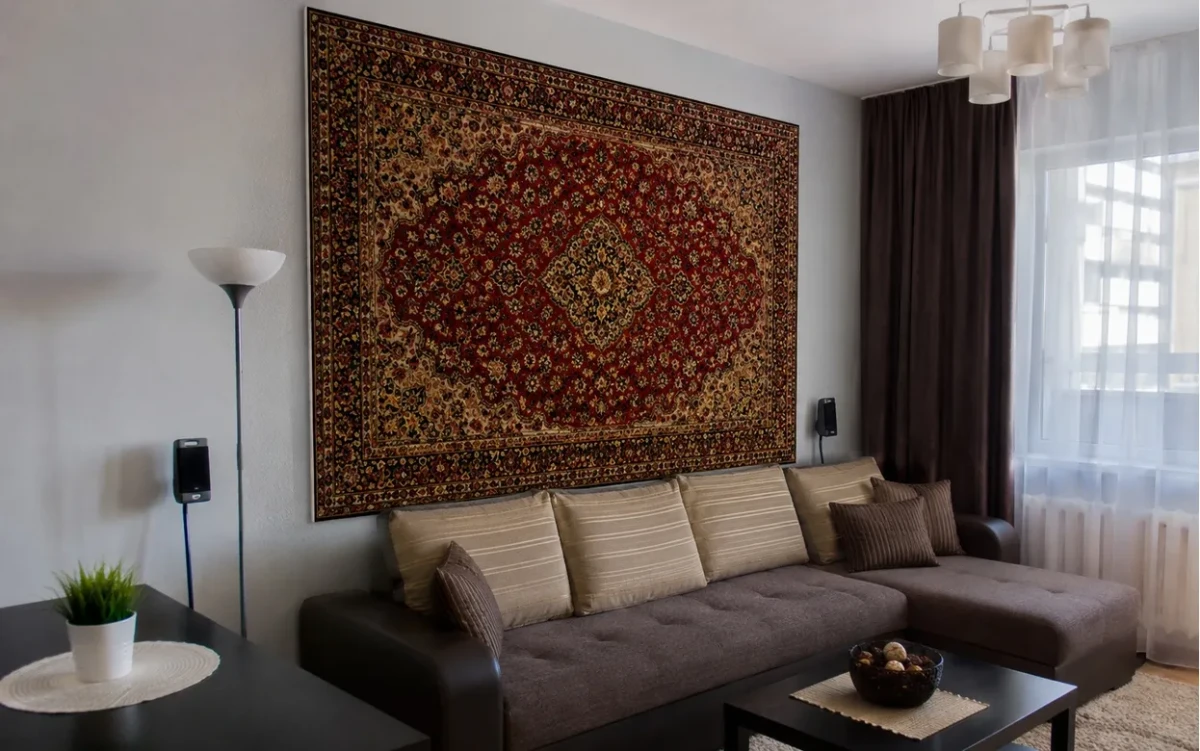
It can be a small accent or a large piece covering an entire wall.
As minimalism slowly fades into the past, the interior design world is experiencing an unexpected return of a legend – the wall carpet. The very carpet that hung over Grandma's sofa and seemed to symbolize Soviet domestic life is now appearing in the apartments of Berlin architects, New York stylists, and Moscow designers. Let’s explore why this is happening and how to avoid looking ridiculous if you want to try hanging one in your apartment again.
Is Fashion Cyclical?
In recent years, interior design has been actively moving away from sterile colors: white walls, bare concrete, and glass surfaces are giving way to warm tones, textures, and personal stories. People are tired of apartments that look like they came straight out of an IKEA catalog. They want spaces that feel like they have character and life.
The wall carpet meets several demands of the modern person. Firstly, it adds texture – something that flat painted surfaces lack. Secondly, it provides sound absorption, which is relevant for urban apartments with thin walls. Thirdly, it is a way to add something unique to the interior that isn’t found in mass-market catalogs.
Pinterest and social media have also played their part: algorithms have started to actively promote the aesthetics of “cozy chaos” and the so-called grandmillennial style – a trend where old items are reinterpreted as luxury objects. The wall carpet fits perfectly into this narrative.
How Does the Modern Approach Differ from the Soviet One?
The Soviet wall carpet hung for one reason: it retained heat in poorly insulated apartments while also serving as decoration. It was typically hung above the bed or sofa. The choice was limited, and the carpets were often heavy, dark, and featured geometric or floral patterns.
Now, the logic is completely different. A wall carpet is chosen consciously, like a painting or sculpture. It can be a small accent or a large piece covering an entire wall, vintage or new, handwoven by a contemporary artisan.
What Types of Carpets Are Currently Hung on Walls?
Berber and Moroccan carpets with geometric patterns are among the most enduring requests of recent years. Their muted tones and textured wool look great in Scandinavian and eclectic interiors. Moreover, each of these carpets has its own story: many are still handwoven in Berber villages.
Kilims – flat-woven carpets with bright geometric patterns – are experiencing a renaissance. They are lighter and thinner than pile carpets, making them appear less bulky.
Furthermore, artisans around the world are creating textile wall objects: from abstract compositions in the spirit of Kandinsky to minimalist monochrome panels with textured pile. Such items are more expensive but also look the part.
Vintage Soviet carpets are also undergoing rehabilitation. Ironically, young designers have started using them as elements of post-Soviet aesthetics, which is in demand, including in the West.
However, one should not forget about Dagestani production. Tabasaran carpets are handwoven from natural sheep wool. The lifespan of such products can reach up to 300 years – almost twice as long as Persian carpets. The color palette is striking: one carpet can have up to 24 shades – purple, raspberry, green, and blue tones woven into geometric patterns with evocative names. For example, the pattern “Safar” is said to be named after a carpet weaver who lost her beloved: it intertwines stylized plants, sheep, and human figures. Even before the revolution, Tabasaran carpets were exhibited in museums in Russia and Western Europe. They can be found directly from artisans in Dagestan through social media and marketplaces.
Where and How to Hang: Practical Tips
The most popular option is above the headboard of the bed. Neutral shades and soft textures are well-suited for the bedroom: they do not overload the space where one wants to relax.
In the living room, the carpet serves as a foundation for other elements: furniture, lighting, decor. That’s why designers recommend starting the room’s decor with the choice of such a carpet rather than finishing with it.
The corridor and hallway are an unexpected but very successful place. A long narrow carpet on the end wall visually elongates the space and immediately sets the character of the apartment.
As for the method of attachment, there are several workable solutions. The most delicate is attachment through a special strip with grips that evenly distributes the load across the entire width of the item. Decorative wooden or metal holders suitable for lightweight kilims can also serve as design elements themselves. Nails and ropes are still an option if the carpet is small and not too heavy.














Leave a comment