
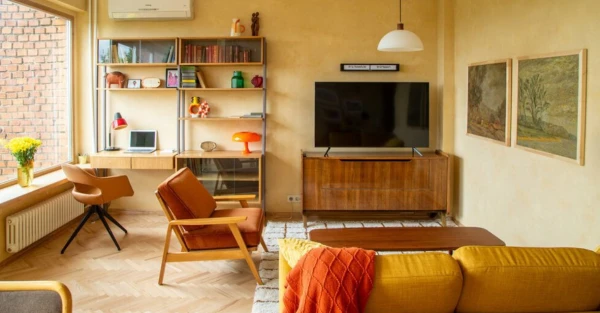
Unique interior items can also be quite functional.
Just ten years ago, grandmother's sideboard seemed like the embodiment of bad taste, wall carpets elicited laughter, and people were ashamed to show their eco-bags in public. Today, designers hunt for these items at flea markets, prices for Soviet vintage rise every year, and Madonna walks around with a reimagined eco-bag. Before you throw away your grandmother's inheritance, check: perhaps there is an interior treasure lying in your attic.
Three reasons explain the return of Soviet vintage.
The first: quality. Furniture in the USSR was made from solid oak, beech, and birch. Sofas were upholstered in genuine leather or dense fabrics. Modern particle board furniture cannot compare in durability. An IKEA dresser weighs 15 kg and starts to wobble after five years. A Soviet dresser weighs 50 kg and has stood firm for sixty.
The second: uniqueness. In the era of mass production, when everyone has the same wardrobes, a vintage item with a history stands out in the interior. A sideboard from grandmother's apartment is now perceived not as an outdated detail, but as a characterful object.
The third: eco-friendliness. Conscious consumption is in trend. Using old items instead of buying new ones is both about saving money and caring for the planet. Why buy a new dresser made of pressed sawdust when there is a sturdy wooden one at the dacha that only needs restoration?
1960s Furniture: A Separate Trend
Soviet furniture from the mid-20th century is characterized by elegance and fine proportions. Nightstands and dressers with tapered legs, rounded corners, and matte wood perfectly fit into the trend of simplicity and minimalism.
What designers are looking for: solid wood dressers, bookshelves with open sections, coffee tables on thin legs, chairs with bent backs. Such furniture easily combines with modern items and serves as a stylish accent.
The bulky sideboard from the 70s is also making a comeback. It is now more often repainted in light shades, the gloss is removed, and it is integrated into kitchens and living rooms as a retro accent. Polished "walls" are harder to fit into modern interiors, but they also find their admirers after proper restoration.
Soviet-era armchairs are a find for vintage lovers. Their simple yet expressive design easily fits into modern interiors. Just reupholster them with contemporary fabric.
Carpets: From Wall to Floor
Red Soviet carpets, which once adorned walls, now look great on the floor. In a minimalist gray or white interior, a bright carpet with an Eastern pattern serves as a powerful color accent.
Handmade carpets from Central Asia and the Caucasus are especially valued. Natural wool, traditional ornaments, natural dyes. Such carpets with slight wear (stone-washed effect) look noble and expensive. A good specimen can fetch tens of thousands of rubles.
What to look for: carpets made of natural wool, with dense pile, without holes or significant damage. Stains and minor wear are not a problem. They can be cleaned or left as is for a vintage effect.
Modern manufacturers have already tracked the trend and are mass-producing carpets with traditional Soviet patterns. But the original is still valued higher.
Crystal and Porcelain
Crystal vases, salad bowls, glasses, and shot glasses that were carefully stored in the sideboard "for guests" are once again brought out for the festive table. And not just for special occasions.
Soviet-made crystal is distinguished by the quality of cutting and play of light. Modern analogs often look cheaper and simpler. Products with hand-cutting and stamps from well-known factories are especially valued.
Porcelain is also in demand. Sets from the Leningrad Porcelain Factory (LFZ), Dulevo Factory, Gzhel, Verbilki — all of this is now antiques valued by collectors. Soviet tableware with polka dots, floral patterns, and cobalt nets is reappearing on tables.
Enameled dishes with bright patterns — flowers, berries, peas — have also made a comeback. Soviet enamel was known for not cracking or chipping. Today, such dishes are used not only for their intended purpose but also as decor elements in retro or country-style kitchens.
Floor Lamps and Chandeliers
Floor lamps with fringed shades and "flower-patterned" or graphic fabrics create a cozy, soft light and a vintage atmosphere. Just recently, they were thrown away, but today such floor lamps are sold in vintage shops.
Chandeliers with thin legs, popular in the 60s, have also returned. They are light, elegant, and do not clutter the space. They are now used in neoclassical and modern eclectic interiors.
Vintage lighting adds warmth and humanity, which is often lacking in a "template" interior.
Eco-Bag: A Symbol of Conscious Consumption
The eco-bag is one of the best examples of Soviet design from an ecological perspective. An Italian designer wrote about it: "If you care about ecological issues and excessive consumption, know that this bag became a viable solution to several problems many years ago."
In the USSR, the eco-bag was used out of necessity, but today it is used out of conviction. Durable, compact, convenient. Modern eco-shoppers are a reimagined eco-bag. By using it, you save on plastic bags and reduce plastic waste.
Developed in the 1930s, the eco-bag very Sovietly excluded the privacy of purchases (everyone could see what you were carrying), but allowed for quick responses to product "drops." Today, that is no longer important, but eco-friendliness and style remain.
Clothing and Accessories
Not only interior vintage is in fashion. Soviet clothing is also making a comeback.
Tracksuits in the spirit of the 80s and 90s are worn in both vintage and modern styles. The padded jacket (vatnik) is popular among zoomers as an "anti-glamour" trend — worn with jeans and chunky shoes.
Wrap dresses, corduroy blazers, oversized cardigans, knitted vests, heavy sheepskin coats in the old money style, evening dresses with sequins from the "shiny" 80s — all of this is relevant again.
As for accessories: floral print scarves (worn both as headwear and on bags), patent leather shoes, vintage glasses.
What was once considered a sign of poverty is now part of identity. Dense fabrics, natural materials, and good cuts by old Soviet standards perfectly fit into the philosophy of "things for the long haul."
What Else Has Returned
Glass blocks. Once an element of factory workshops and entrances, now a fashionable way to create a partition in the bathroom that lets in light.
Terrazzo. Concrete floors with marble chips, familiar to everyone from Soviet government institutions, are back in trend.
"Cabanchik" tiles. A nod to the Soviet metro now adorns kitchens and bathrooms in modern apartments.
Veneered walls in the style of late modernism. Textiles with 60s-70s geometry. Large floor vases. Radios that are being modernized by adding Bluetooth.
Interior doors with glass inserts, which were in every Soviet apartment, are also finding their admirers.
How to Use Soviet Vintage
One or two Soviet items in a modern interior work as a stylish accent. There is no need to turn your apartment into a museum of the USSR. A "vintage-style" dresser next to a modern sofa or a vintage lamp in a strict office is enough.
The contrast of new and old is an expressive means of decoration. An old carpet against minimalist furniture. A crystal vase on a modern shelf. A Soviet armchair with new upholstery.
Do not be afraid to mix retro and modernity. Use items not only for their intended purpose. A Soviet dumpling maker can become a cookie cutter, and an eco-bag can be a stylish accessory.
Sometimes an item from the past holds memories that are more important than any purchase. Soviet vintage is not just about fashion. It is about the connection between generations, about family history, about items that have witnessed the lives of your parents and grandparents. In an era of disposable goods, such items acquire special value.









Leave a comment