
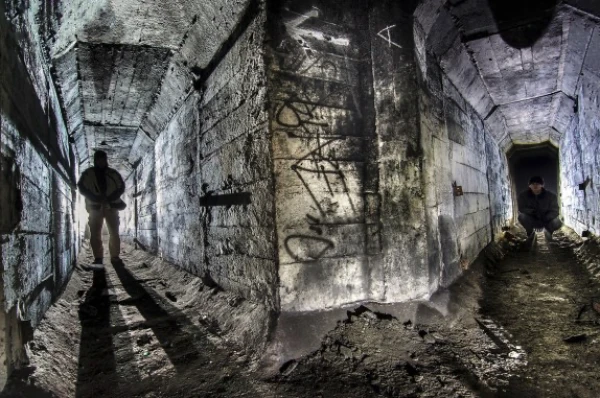
It has become known that Latvia will provide Ukraine with a dismantled thermal power plant. The exact location of the power plant's liquidation has not been disclosed, but it may refer to the secret underground power plant built during the presidency of Kārlis Ulmanis near Lake Bebelitis in Riga in case of war. At one time, this power plant was the most modern special project of its kind not only in the Baltic States but throughout Europe. This plant was blown up by the Germans during their retreat from the Latvian capital during World War II and was restored during the USSR.
What it's about: the head of the Latvian Ministry of Foreign Affairs stated the transfer of a thermal power plant to Ukraine that "Latvia no longer needs." Details about what this plant is have not been disclosed.
As the BB.lv portal found out, it may refer to a secret underground power plant that was located in the forest near Lake Bebelitis in Riga - an area near Jugla - which was dismantled in 2017 by the company Rīgas meži.
This power plant was built over 80 years ago in 1939 in case Latvia's capital needed to be supplied with electricity during wartime.
The portal from neighboring Lithuania, Pamiršta.lt, took a tour of the site of this power plant in Riga and shared photographs, calling the place by Lake Bebelitis "the calling card of the Latvian capital." "This is a place you won't see anywhere else in the Baltic States — an underground power plant built during the interwar period on the outskirts of Riga," the portal reports.
The history of the power plant begins in 1939, when the threat of war loomed over Europe, and the government of President Kārlis Ulmanis decided to take the initiative by proposing to build a backup power plant in case the main capital Kegums power plant was damaged or destroyed.
According to the plan, the new power plant with a capacity of 10 MW was supposed to automatically start within 15 minutes in case of war and connect to the main power supply system of Riga, providing electricity to key urban infrastructure — tram lines, hospitals, clinics, and government institutions.
The opening ceremony was attended by President Kārlis Ulmanis himself, as the fully automated power plant of this type was the first not only in the Baltic region but in all of Europe. It was immediately nicknamed with the concise call sign "K" (from the Latvian word kara — "military").
"The further history of the station is unclear. It is known that from 1942, during the German occupation, it was successfully operated. In 1944, while retreating from Riga, the Germans blew up the power plant along with other strategic facilities in Latvia. And although serious damage immediately dashed hopes for its restoration, the Soviet authorities soon handed over the remains of the station to the Riga Aviation Technical School, which converted the surviving fuel tanks into storage for heating oil and used the territory until the 1980s," reports Pamiršta.lt.
The heart of the Bebelitis power plant is a huge generator hall 32 meters long, 12 meters wide, and 5 meters high, protected from above by thick reinforced concrete ceilings and well hidden from prying eyes in the forest next to Lake Bebelitis.
This room housed the main turbo generator with a capacity of 10 MW, intended to ensure uninterrupted power supply to Riga, batteries necessary for system startup, as well as auxiliary mechanisms — water pumping stations and additional diesel generators.
This hall was connected by tunnels 1.8 meters high and 0.9 meters wide to two huge underground fuel tanks (10 meters in diameter and 6 meters high), each with a capacity of 3000 cubic meters, intended for fuel storage.
Since the power plant was fully automated and autonomous, no staff rooms were provided. The only exception was a small operator's room intended for an employee monitoring the operation of the station.
Now this power plant, according to the head of the Latvian Ministry of Foreign Affairs Baiba Braže, has turned out to be unnecessary for our country.








Leave a comment