As is often the case with Americans, the literary foundation of the film fell short.
The third installment of James Cameron's 'Avatar' franchise has hit the screens, showcasing the evolution of 3D technology and the absolute helplessness of the script.
The first part of 'Avatar' was released in 2009. In fact, Cameron began developing the idea back in 1997, but, by his own admission, the lack of suitable technology hindered him from realizing his vision. The technology, as if on cue for Cameron, has caught up and evolved. And, of course, the difference between the 3D we experienced in the first 'Avatar' and today's effects is monumental. The problem is this – while the new 3D experience, anti-colonial vibe, and eco-activism were still novel in 2009, by 2025, the conflict between beautiful natives and vile colonizers on terrifying war machines seems politically relevant but artistically derivative. Moreover, the idea, along with the script twists, travels from series to series in the franchise so unimaginatively that only the technology saves it. And there's also a new heroine who brings fire to the new three-hour saga, pardon the pun.
So, 'Avatar: The Way of Fire and Ashes'. Jake Sully and Neytiri continue to live with the Metkayina tribe, where the family fled in the second part of the franchise subtitled 'The Way of Water'. Their activities are not diverse: Neytiri continues to mourn the death of her tribe, the loss of their home tree, and to hate humans, while Jake mourns the death of one son and blames the other for it, all while preparing for war against the humans from the RDA corporation, who dream of colonizing Pandora, as humanity has made Earth uninhabitable by the 22nd century. Humans have also changed little in the fifteen years since the first landing on Pandora – greedy for money and resources, they continue to ruthlessly kill and destroy everything in their path. The eternal antagonist of Jake, Colonel Miles Quaritch, appears in avatar form, as his human shell was broken in the previous part. In this confrontation (or preparation for another round), years and hours of screen time pass – the runtime of 'Avatar-3' is over three hours.
The first two parts of the franchise were built around this confrontation while simultaneously immersing viewers in the amazing world of Pandora – in the first, Jake explored the secrets of the Na'vi tribe, which lives in complete harmony with nature and literally in a tree, while in the second, he, along with Neytiri and their children, had to explore a new element – the water world, in which the Metkayina tribe that sheltered them exists. In the third part, Cameron decided it was time to stop entertaining viewers with the wonders of Pandora and to introduce them more closely to the inner world of the characters, as well as to another tribe – the fire tribe. The complex psychological dilemmas facing the characters are resolved quite straightforwardly. For example, Jake will have to rethink his role as a father twice (here the screenwriters didn't put in much effort and simply adapted a rather boring moment from the biblical story of the sacrifice of Isaac). Neytiri faces the difficult process of accepting that she has been married to a representative of the despised human race for 15 years, and that her children are half-breeds. Jake unexpectedly acts as a true preacher, explaining to his wife that despite her hatred for humans in general, the sentiment 'they are all like that' does not hold up under scrutiny in her situation. Colonel Quaritch becomes lost between his hatred for Jake and his love for the son that Jake has taken into his family, and now that ridiculous little monkey, compared to the gigantic natives, jumps with them through the trees because he chose them over the world of humans. The children also have a hard time – for all three hours, they will have to run, fly, swim, hide, survive, run again, and jump.
Because the adults have organized such an unpleasant world for them that there is no other option. Perhaps the only truly curious plot point is the sudden love that descends upon Colonel Quaritch in the form of the leader (or leaderess) of the fire tribe, Varang, played by Charlie Chaplin's granddaughter, Una Chaplin. Here, one can't help but reflect on genetics, because against the backdrop of the rather banal and straightforward roles of the other characters in the film, Chaplin's acting charisma is truly mesmerizing. It is no coincidence that the soldier Quaritch falls under the spell of her character instantly and hopelessly – her feline grace, in which the smoothness of a seductress and the readiness of a killer are inextricably fused, is effectively contrasted with Neytiri's weary confusion. Their confrontation is predictably paralleled with the enmity between Jake and Quaritch. But the bright idea never transforms into a vivid story. Several excellent episodes with Varang get lost in the whirlwind of dizzying special effects and the grand scene of the final battle, which leaves the feeling of day-before-yesterday's soup – its logic has been repeated so many times in various scripts that every twist and ending is known in advance.
Of course, 'Avatar' is not arthouse cinema, and fans do not expect cinematic or substantive depth from it, but the second-rate nature of the script of 'The Way of Fire and Ashes' is simply impossible to overlook. The repeatedly recurring plot loop throughout the three hours of 'caught in a desperate situation/miraculously saved/got stuck again', the pompous dialogues about the value of family, identity, spiritual connection to one's land, and acceptance of the other today migrate from one Hollywood film to another almost unchanged, becoming a parody of themselves. The characters, like flies in amber, are stuck in their own roles: the dim-witted but noble warrior, the grieving exile, the soldier, the sexy pyromaniac, and so on. The evil colonizers, who not only offend the natives but also animals, of course, and if you suddenly don't believe it, here are close-ups of the wounded body of a whale-like creature from all possible angles (this invites an association with the perception of the Palestinian-Israeli conflict in the Western world, but let's stop there).
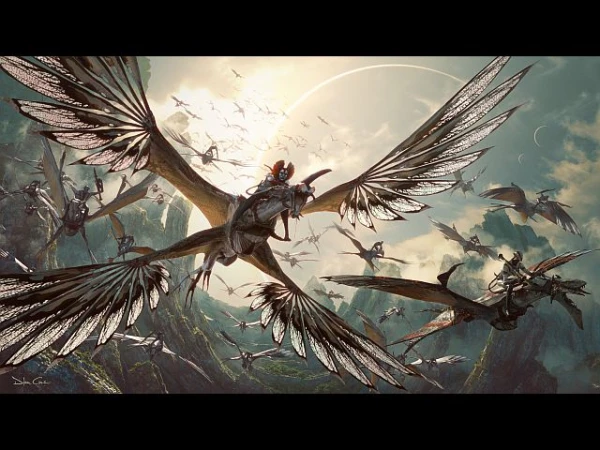
All of this could rightly be called a collection of poorly glued clichés if it weren't for the visual execution. And so here comes a completely unexpected recommendation: despite all the previous unforgivable flaws for a recognized master of cinema, go see 'Avatar 3'. But definitely in IMAX (in Israel, unfortunately, there are only three such theaters, but it's worth it) and definitely with children. Judging by the quality of the picture, all 400 million dollars invested in the film went to shooting and visual effects. 'Avatar: The Way of Fire and Ashes' is not a movie but a dizzying attraction, in which viewers soar into the sky with the characters for three hours on ikrans (the local dragons), dive underwater at breakneck speed, travel on extraordinarily beautiful airships, fall from cliffs, jump through trees, shards from explosions fly into their faces, and terrifying harpoons from military ships pierce them, while the otherworldly flowers of the earth goddess Aiya bloom literally in their palms. Honestly, for my ten-year-old son, this was perhaps the most vivid impression of his rich life filled with experiences and travels. And I hope that adults will get to enjoy the dizzying technologies combined with a deep plot next year when Christopher Nolan's 'Odyssey', also shot in IMAX format, hits the screens.