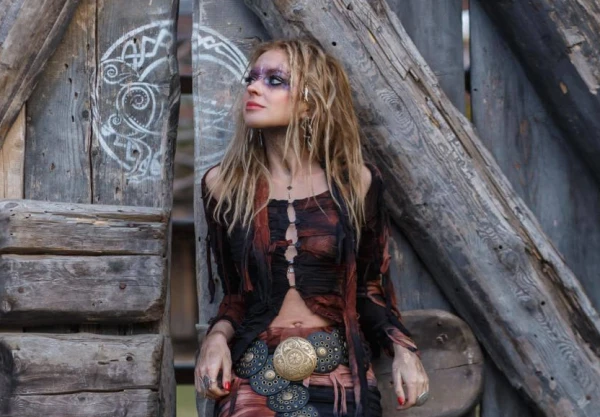
Radveda — this is now how she is called in official documents.
Natalia Poklonskaya, advisor to the Attorney General of Russia, explained why she changed her name to Radveda. She shared her reasons in an interview for RTVI.
According to Poklonskaya, she indeed changed her name, but she did not plan to inform the public about it. Radveda — this is now how she is called in official documents — is a name taken from legends and myths.
"If you translate from some traditional and ancient legends, myths, there are many versions, I have read a lot about this name. But initially, I read legends and myths, and information that it means 'morning dawn', 'star', well, something beautiful like that," Poklonskaya told the publication.

However, people still address Poklonskaya as Natalia.
At the end of October, television host Sergey Mardan stated that Poklonskaya changed her name, providing part of the lawsuit as evidence. According to Mardan, the advisor "completed the rite of un-baptism." In the RTVI interview, Poklonskaya confirmed that she consciously left Christianity.
"I can generally say to everyone, to every person: to study or draw conclusions about any religion, you need to study it from within, to immerse yourself completely. And I immersed myself completely," Poklonskaya said.
She added that she is interested in ancient cultures, traditions, pre-Christian beliefs, and is also collecting materials to write a scientific paper.
Natalia Vladimirovna Poklonskaya (née Dubrovskaya; born March 18, 1980, Alekseyevka, Voroshilovgrad Oblast, Ukrainian SSR, USSR) is a Ukrainian, later Russian state official and lawyer. She has been an advisor to the Attorney General of the Russian Federation since June 14, 2022. She is a State Justice Advisor of the 3rd class (2015).
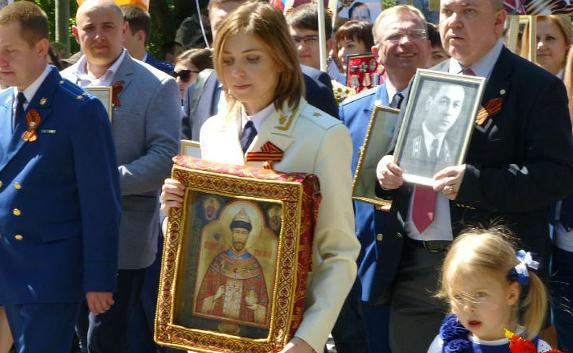
She served as Deputy Head of Rossotrudnichestvo (February 2, 2022 — June 13, 2022). She was the Extraordinary and Plenipotentiary Ambassador of the Russian Federation to Cape Verde (October 13, 2021 — February 2, 2022). She was a Deputy of the State Duma of the VII convocation (September 28, 2016 — October 12, 2021). She was the Prosecutor of the Republic of Crimea (March 25, 2014 — October 6, 2016).
She worked in the prosecution authorities of Ukraine (from 2002 to March 17, 2014). In particular, she was the prosecutor of the Autonomous Republic of Crimea (from March 11 to March 17, 2014). She was a state prosecutor in high-profile criminal cases, one of which involved the organized crime group "Bashmaki," one of the largest criminal groups in Crimea. In 2014, she was put on the wanted list by the Security Service of Ukraine and the Ministry of Internal Affairs of Ukraine under Article 109 Part 1 of the Criminal Code of Ukraine — "actions undertaken with the aim of violent change or overthrow of the constitutional order or seizure of state power, as well as conspiracy to commit such actions."
Poklonskaya gained fame in March 2014. In May 2014, she took office as Prosecutor of the Republic of Crimea. Poklonskaya is considered the main fighter against corruption and organized crime on the peninsula, resulting in criminal cases being opened against several officials in Crimea by law enforcement agencies. As someone involved in the annexation of Crimea by the Russian Federation, she is under personal sanctions from 27 countries of the European Union, the United Kingdom, the USA, Canada, Norway, Switzerland, Australia, Japan, and other states.
<iframe width="560" height="315" src="https://www.youtube.com/embed/bDKrXlwmwU0?si=yoE4Qfg6pe1s7f4w" title="YouTube video player" frameborder="0" allow="accelerometer; autoplay; clipboard-write; encrypted-media; gyroscope; picture-in-picture; web-share" referrerpolicy="strict-origin-when-cross-origin" allowfullscreen></iframe>