This outstanding success in archaeology is the result of years of meticulous work by an international team of specialists who managed to literally piece together the history, nearly destroyed by relentless time and natural disasters.
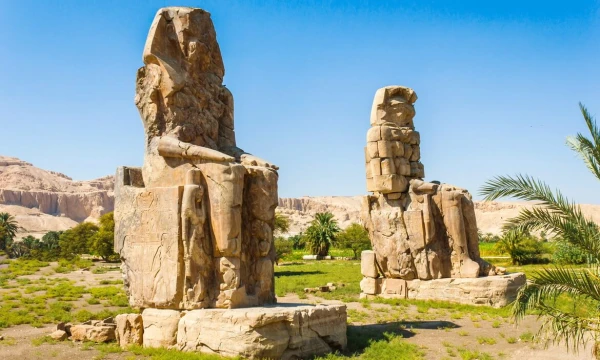
The fate of these statues unfolded like a true drama. Initially, they served as guardians at the entrance to the mortuary temple of Amenhotep III — a grand cult structure of antiquity, considered the most luxurious and monumental of its kind, surpassing even the famous Karnak. However, a powerful earthquake in 27 BC reduced the temple to ruins, and a deep crack formed in the northern colossus. It was then that the legend of the 'singing stone' arose: due to temperature fluctuations at dawn, the statue emitted a thin sound resembling a whistle or moan, which the ancient Greeks interpreted as a greeting from the hero Memnon to his mother — the goddess of the dawn, Eos. Even after the crack was repaired in AD 199 on the orders of Roman Emperor Septimius Severus and the colossus 'fell silent', interest in these monuments did not fade away.
The modern phase of restoration, led by Dr. Khurigh Suruzian, has become the most extensive in the history of the monument. Restorers faced serious challenges: elevated groundwater levels, the destructive impact of salts, and intense stone erosion. During the work, specialists not only reinforced the foundations of the 18-meter giants but also discovered numerous fragments of other statues, long hidden beneath the ground. Among the finds were parts of stelae, images of deities, and elegant sphinxes that once adorned the temple avenues. Each element — from the multi-ton blocks to the smallest decorative details — found its place in this vast historical mosaic.
The Egyptian Ministry of Tourism and Antiquities emphasizes the exceptional value of the project for the preservation of world heritage. Cleaning the stone from centuries-old layers of dirt and soot allowed the fine carvings on the pharaoh's thrones, depicting the Nile god Hapi, symbolizing the unity of Upper and Lower Egypt, to be seen once again. Today, the restored colossi stand not only as silent witnesses to the grandeur of the 18th dynasty but also as a symbol of human perseverance triumphing over the destructive force of time. In the rays of the setting sun, their majestic silhouettes remind us once again that true art can outlive empires, earthquakes, and oblivion, remaining an eternal pillar of human memory in a constantly changing world.