
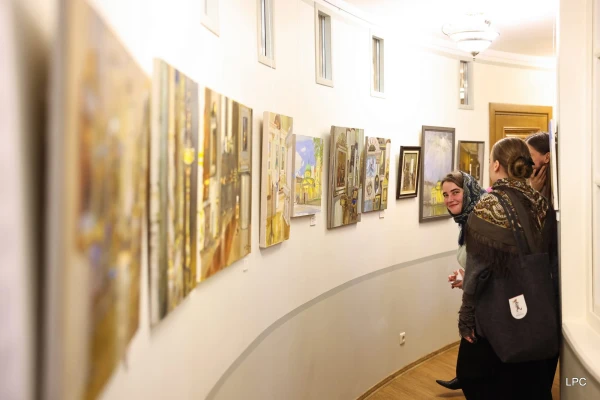
Ahead of the two-hundredth anniversary, an exhibition of participants from the festive plein air was presented at the church.
A Ray of Light on Brivibas Street
The cathedral stands out brightly on the main thoroughfare of the Latvian capital. Even in gloomy winter weather (or rather, bad weather), it shines with its quite picturesque yellow color.
In summer, under the shining sun, it plays with its colors, while in winter and during dark hours, there is lighting. For many, the church is a ray of light.
The cathedral is an architectural monument, built two centuries ago on public donations, with the main benefactors being the Riga merchants Pavel Grachov, Mikhail Bodrov, and Mikhey Popadyin. Under any circumstances and changes in government, during any global turmoil that affected the history of Latvia, the cathedral continued to operate, and it is visited not only by Russian parishioners but also by representatives of various nationalities.
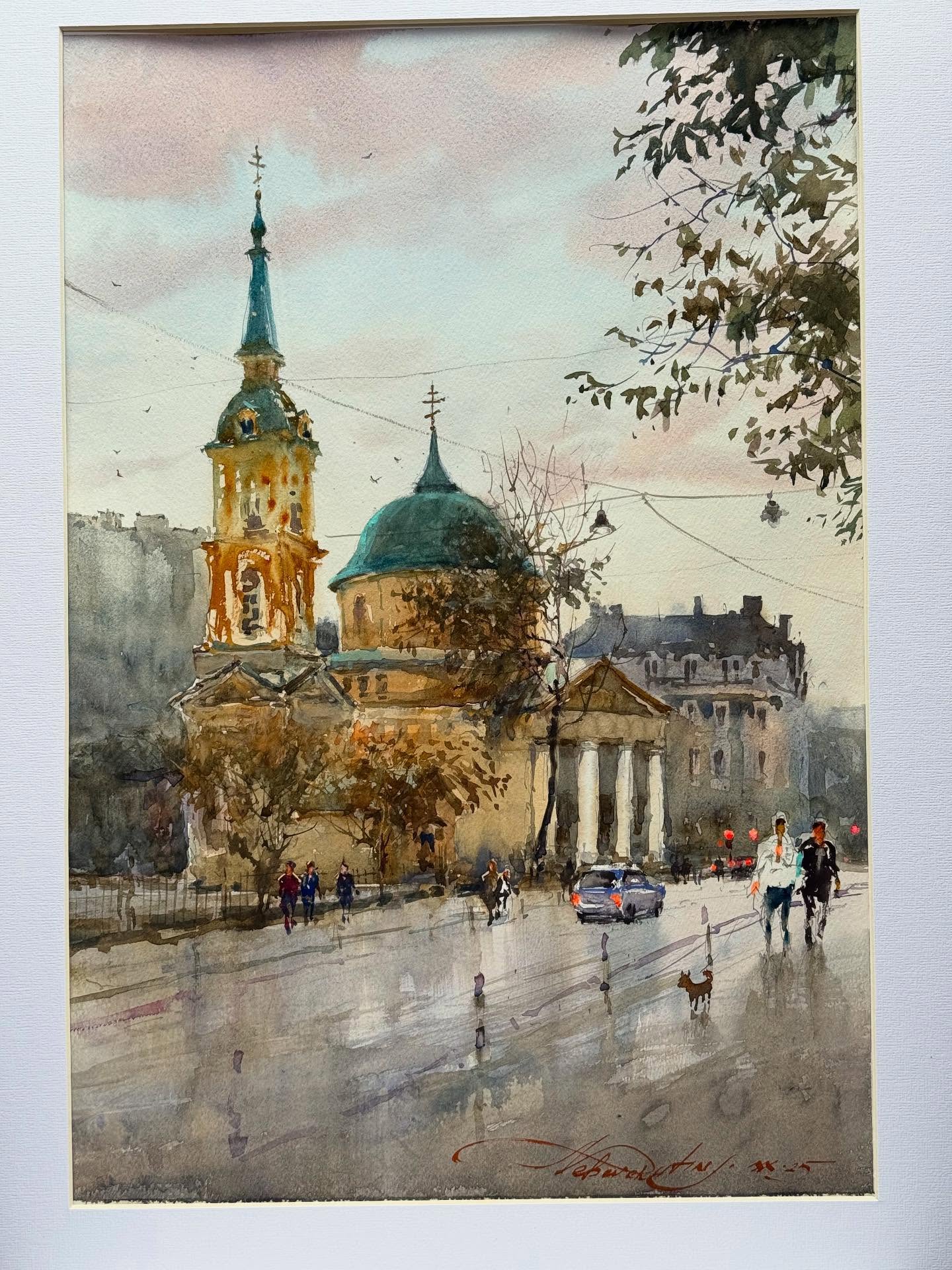
The plein air in honor of the anniversary took place in August, and the exhibition "The Cathedral in Colors" is currently being held during the anniversary days in the luxurious colonnade of the church. This event was also timed to coincide with the presentation of an excellent catalog featuring the works of the participants.
Among them is the color of Russian painting in Latvia - the president of the Latvian Watercolorists Association Alexander Neberekutin and his wife Natalia Neberekutina, master of non-objective painting Nikolai Krivoshein, artist from Madona Valery Baida, Andrey Severetnikov, a teacher at the Spiritual Academy in Dubulti Vladimir Babkin.
The event also featured Elmar Magaramov, who has Azerbaijani roots. Along with respected Latvian artists, many of whom are also parishioners of Orthodox churches. This includes the wife of Valery Baida, Maya Yakovich, Liga Kempe, Inta Pauluka, Olga Kviese, the famous artist and scenographer Ieva Jurjane (who has worked at the Latvian National Opera, the New Riga Theatre, and La Scala in Milan), painting teacher at the Latvian Academy of Arts Atis Jakobsons, as well as 84-year-old classic of Latvian painting Juris Hermanis.
The Sound of the Bell
The results of the plein air were presented in the colonnade of the church as part of the exhibition. This includes several dozen works depicting services in the church, the church itself, as well as views from Brivibas Street and from the courtyard where the bell tower, built in 1863, stands.
The bells (6 in total weighing 4439.966 kg) were evacuated to Nizhny Novgorod in 1915 due to the outbreak of World War I and were never returned.
At the end of 1925, in honor of the centenary of the cathedral, a new bell was raised to the bell tower, constructed from donations from parishioners and pilgrims (the cost of the bell delivered to Riga was 6,000 lats). This anniversary bell was cast at the Liepaja Joint Stock Company B. Becker, weighing 1736.733 kg.
One of the notable events at the opening of the exhibition was a greeting to the artists from the Metropolitan of Riga and all Latvia Alexander, read by one of the organizers of the plein air, Father Ioann.
"Dear painters, each of you has been given by the Lord the opportunity to create beauty," the archpastor writes. "Contemplating beauty, a person mentally, with spiritual eyes, elevates his soul to the source of beauty, which our dear Lord, the Creator, gives, for He Himself is the complete true beauty. Today, on this day of God's mercy, we have the opportunity to see your wonderful artistic works that bring beauty into our world, so that we may learn and seek the beautiful. By creating and giving this beauty to people, your hearts are filled with joy from the soul, love, and goodness.
I am very glad today about this exhibition dedicated to the amazing Orthodox cathedral of Alexander Nevsky in the city of Riga. I sincerely wish all of you the development of the talents given to you by God and heartily thank you all for your noble labors. And may the Lord bless you all in your further creative efforts to bring a reflection of divine beauty into our restless, tumultuous world."
And with particular joy, the artists noted the fact that in this same message, the Metropolitan invited all artists to the Riga Holy Trinity Sergius Women's Monastery for a new plein air in the summer.
"And this can be done in warm weather when the monastery gardens and flowerbeds begin to bloom."
What Does Christmas Mean for Artists?
The realist artist Andrey Severetnikov, living in a farmhouse near the Estonian border, has a truly bright persona. "For me, Christmas is the birth of our Lord Jesus Christ. And what else is there to explain? This inspires the creation of beautiful works! Faith, an unclouded view of the surrounding reality, and the native nature help."
Nikolai Krivoshein, known more as a master of non-objective painting, an abstractionist, says: "For me, Christmas is a return to traditional, Christian, Orthodox values. It is a bright holiday. He was born and saved us all subsequently."
One of the organizers of the plein air and exhibition in honor of the cathedral's anniversary is Neonilla Medvedeva, who is not only an artist but also a singer in the church choir.
"Christmas is, of course, primarily an Orthodox church holiday for me," she says. "And I celebrate the birth of the Savior. Just during the holidays, I start a singing marathon, as I am a parishioner of the Alexander Nevsky Cathedral. Starting from January 6, on Christmas Eve, I begin to sing the liturgy. And this is how we all together begin to glorify God, including the artists."
By the way, simultaneously with the cathedral's anniversary, an exhibition titled "Christmas Mood" opened at the gallery "Ark," which was established more than a year ago in the hall of the Orthodox Church in honor of all saints (Riga, Katolu Street, 8). The gallery director, artist Marina Lapteva (who is also a singer in the choir), speaks about Christmas this way: "Christmas for me is the beginning of a new period, undoubtedly accompanied by God's blessing. Therefore, there are many landscapes here. That is, again, it is a gift of nature for all people."
As for the difference in calendars (Orthodox Christians, unlike Lutherans and Catholics, celebrate Christmas thirteen days later) - this is not the main thing.
"We celebrate Christmas in the Orthodox way, we deeply honor, love, and respect Christmas in the Gregorian style. It is wonderful and very good that we have the opportunity to meet the Lord both earlier and later, and vice versa. Therefore, I see nothing contradictory here. And I am glad that art attracts people. For example, here, alongside well-known artists, there was an introduction to the work of a new author, who is participating for the first time. Her name is Snezhana Loginzka. The work is significant - 'The Birth of Our Lord Jesus Christ.' Snezhana is a parishioner of the Riga Church of Archangel Michael.







Leave a comment