Researchers have long struggled to understand why a massive amount of locusts emerges after the first rains in arid regions of Africa. It turns out that the insects lay eggs in the soil, which in a ‘dormant state’ can wait for the first drops of rain for months.
Several years ago, the provinces of Northern Cape and Eastern Cape in South Africa faced the longest drought in the last hundred years. A seven-year period without rain, which began in February 2013, caused significant damage to the sheep farming operations in the region.
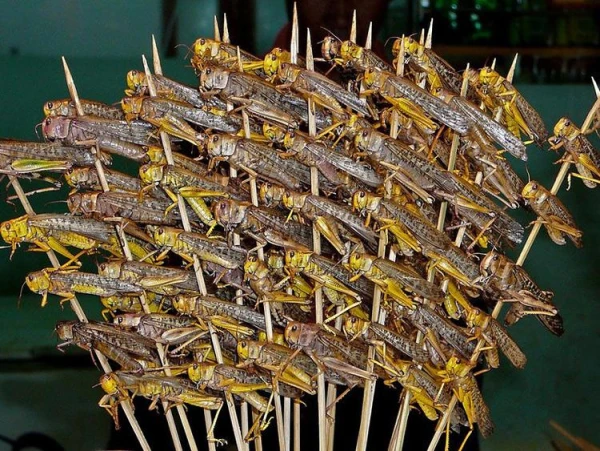
When summer rains finally began in October 2020, farmers had to confront a new threat — massive swarms of locusts. The brown locust, which inhabits this area, primarily feeds on grass but also destroys any green plants, including cornfields.
Both provinces are part of the Nama-Karoo, a vast arid region dominated by low shrub vegetation. The last locust outbreak in this area was recorded in 2012, raising an interesting question: how did the insects manage to survive the prolonged drought and reproduce so quickly after the rains?
The answer lies in the fact that the eggs can survive in the soil for several years, and the embryos develop at varying rates depending on environmental conditions.
The brown locust (Locustana pardalina) is a species adapted to arid climatic conditions and endemic to South Africa. This species differs from the migratory locusts found in other parts of the continent. Locusts regularly gather in swarms in the Nama-Karoo region, and these outbreaks can spread to the southern areas of neighboring Namibia and Botswana.
Female brown locusts Locustana pardalina can lay up to several hundred eggs at a time. Typically, egg batches contain between 200 and 400 eggs, although this number can vary depending on habitat conditions and food availability.
On average, a female lays about 380 eggs over her lifespan in 6-10 separate nests. The eggs are protected while in the soil and have a porous cap. They are highly resistant to drought and remain in the soil until they receive enough moisture to hatch. Each egg contains an embryo that will eventually become an adult.
Recent studies have shown that embryo development is quite complex. In some eggs, there is a delay in embryo development regardless of available moisture, while in other eggs, the embryo begins to develop as soon as water is present.
Both types of eggs can be found in the same batch. All embryos of both types can slow down their development under unfavorable environmental conditions. Thus, the eggs can remain in the soil for several years, waiting for sufficient moisture to complete their development.
This leads to synchronous hatching when there is enough rain, as all embryos are at the same stage of development, regardless of the timing of egg laying. Solitary females tend to lay eggs in the same locations, leading to the accumulation of eggs.