Deadly spores proved powerless.
Arachnologists have described a new species of spider that mimics the appearance of a dead individual infected by a parasitic fungus to attract less attention from predators. In nature, such a fungus infects its host and affects its nervous system, causing it to climb to a height from where it can more easily spread its spores. This discovery will expand scientists' understanding of mimicry in animals.
Parasitic fungi of the genus Ophiocordyceps and related Gibellula are a real nightmare for many insects and arachnids. Their life cycle begins with a spore landing on the body of a host, such as a spider. Germinating, the spore forms a germ tube that penetrates the exoskeleton using specialized structures and enters the host's body. After this, the fungal cells spread through the hemolymph — the fluid filling the body cavities and performing blood functions in arthropods.
The fungus then begins to reproduce actively, affecting the spider's physiology and behavior, likely through chemical influence on the nervous system. The infected host leaves its safe shelter and moves to an open area at a height where conditions are favorable for spore dispersal.
When the host dies, the fungus grows through the exoskeleton — including through the initial points of entry — and forms long spore-producing structures from which spores are dispersed.
Due to this behavior, scientists have dubbed these fungi "zombie fungi." Ophiocordyceps, in particular, inspired the creators of the video game and television series "The Last of Us" with the image of a parasitic fungus capable of controlling its host.
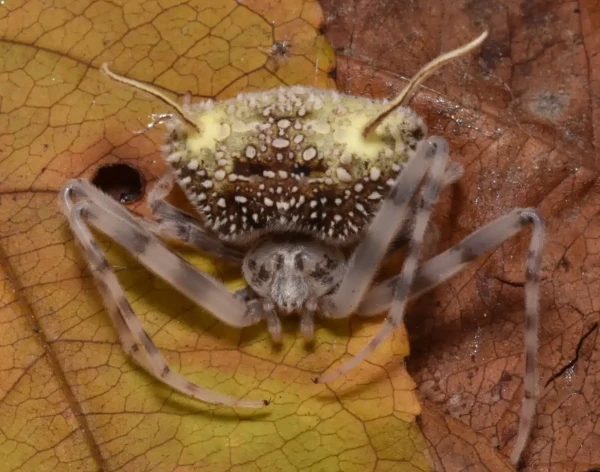
In August 2025, during a tour in the Ecuadorian Amazon, herpetologist and founder of the conservation fund Waska Amazonía, Alexander Bentley, believed he had found a representative of Ophiocordyceps. He noticed characteristic yellowish spore-producing structures resembling tentacles — a sure sign that Ophiocordyceps had killed its host and was preparing to disperse spores.
Bentley touched the "fungus" with a stick, but contrary to expectations, it moved. At first, the scientist assumed that perhaps the fungus had learned to control the host's body even after it had grown outward. But it turned out that Bentley was mistaken.
The researcher posted a photo of the specimen on the nature enthusiasts' social network iNaturalist in hopes of getting additional information from specialists. Users of the platform suggested that the scientist had actually seen a spider that was camouflaging itself as an infected creature.
Then Bentley passed the specimen to a colleague — arachnologist David Ricardo Díaz-Guevara from the National Institute of Biodiversity of Ecuador. After studying the spider's structure, Díaz-Guevara was puzzled: he realized that he was looking at a representative of the rare genus Taczanowskia. Further analysis revealed that this was an unknown species to science. It was named Taczanowskia waska. The spider was not infected but merely copied the appearance of a dead individual affected by the parasite.
To understand the mechanism of mimicry, Díaz-Guevara and his colleagues placed the spider in a laboratory. They observed its hunting behavior, movements, and studied the structure of its organs. It turned out that the spider had developed special protrusions on its abdomen that mimic the spore-producing structures of the parasitic fungus — the very ones that break through after the host's death and disperse spores.
Díaz-Guevara explained: in the course of evolution, the spider "learned" to copy the appearance of a victim to avoid being caught by a predator. Those who might prey on it steer clear of infected creatures — otherwise, they themselves become prey to the parasite.