Never, but crayfish can produce sounds.
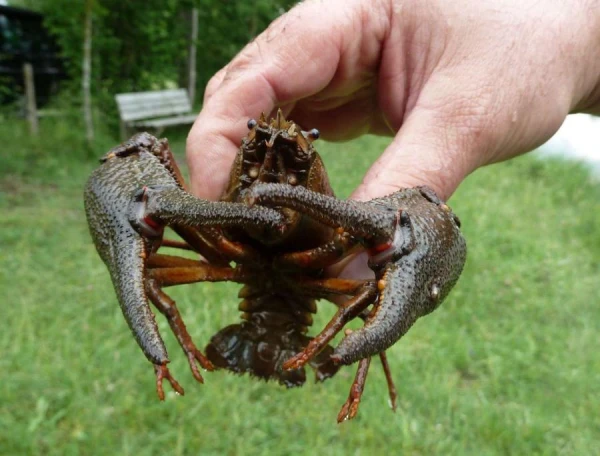
The Russian proverb symbolizes the complete impossibility of any event. The creators of this phrase were convinced that crayfish — inhabitants of the riverbed — would never leave their habitat, come onto land, and, moreover, start whistling. Modern science confirms this: river crayfish indeed cannot perform such actions.
However, if we pay attention to other representatives of crustaceans, we can discover amazing vocal abilities. Of the approximately 40,000 known species of crustaceans, not all are strictly tied to the aquatic environment, and some of them can produce sounds.
The most famous are fiddler crabs, or calling crabs (in the photo above), which inhabit the intertidal zone of tropical seas and can stay on land for long periods. They cannot whistle, as lungs are necessary for that, and crabs, although they come onto land, breathe through gills, just like their aquatic relatives. Nevertheless, they have learned to communicate using sounds — tapping by striking their claws against the ground to warn the colony of danger.
Snapping shrimp, which inhabit shallow marine waters, can produce clicking sounds with their claws. This is not just a tap. When a shrimp strikes with the “movable” finger of its claw against the stationary one, a cavitation effect occurs: a sharp drop in pressure in the liquid leads to the formation of gas bubbles, which is accompanied by a loud sound.
Many species of lobsters — large sea crustaceans without claws — can also produce crackling and grinding sounds. They produce sounds differently, as if playing a string instrument. At the base of the lobsters' antennae, there is a ridge that is used as a bow, with which the lobster rubs at high frequency against a growth on its head — the “file.” The pitch and volume of the sound can vary depending on the pressure applied by the bow.
For whom this “music” is intended is not exactly known. It is likely that lobsters use sounds to deter predators, as they most often produce them in moments of fear. Although this is not proven, it cannot be ruled out that they communicate with their relatives in this way.
Nevertheless, the organs for perceiving sound vibrations in crustaceans are quite imperfect: they are bristles scattered throughout the body. It is hard to imagine that they can catch subtle differences in pitch and amplitude of sound, but perhaps they are capable of determining the source of the sound. In the USA, a method for catching commercial crayfish has even been developed, based on attracting them using the transmission of sounds made by their relatives while feeding.