
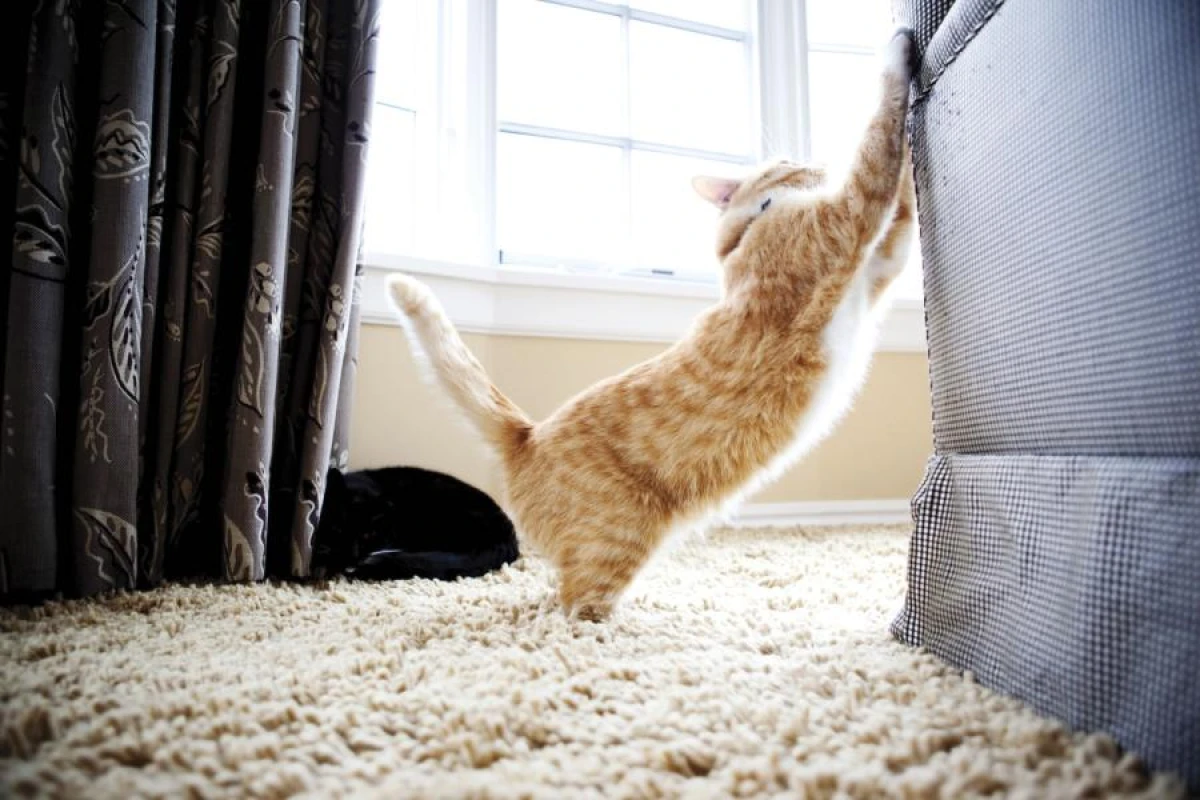
Wild cats prefer to scratch their claws on trees, while their domestic counterparts often damage furniture and fresh wallpaper. Let's consider how to protect the interior from cat claws without harming the pet.
Reasons Why Cats Scratch Furniture and Walls
There are several factors that contribute to this behavior. The first and most obvious is the need to remove dead parts of their claws, which grow and change throughout the animal's life.
The second reason is that the cat marks its territory. It has special glands between its toes that secrete a fragrant substance. With this, it marks its possessions, including items and even its owner, creating a sense of security. However, this scent fades quickly, so the animal has to constantly refresh its markings.
The third reason is a way to relieve stress. If a cat is scared, its desires are not met, or it is hurt, it may scratch to self-soothe. This applies not only to negative emotions. For example, if a cat starts scratching on a scratching post when its owner returns from work, it means it is very happy and excited.
The fourth reason is stretching. Many owners notice that after waking up, their pet stretches by gripping something with its claws. This helps it stretch and warm up its muscles.
Risks of Declawing Cats
The most radical and concerning method of preventing furniture damage is onychectomy, known in veterinary clinics as “soft paws.” In reality, this is a traumatic surgery where not only the claw is removed but the entire distal phalanx of the toe is amputated. Although after such a procedure the apartment's interior will be safe, the pet may face numerous consequences. Changes in gait can lead to musculoskeletal problems, and the lack of claws will worsen coordination and increase anxiety due to the inability to use its “weapon” as intended. In some cases, this may lead to aggressive behavior.
To solve the problem of damaged furniture and walls without risking the pet's health, it is best to equip the apartment with a sufficient number of scratching posts.
How to Determine the Number of Scratching Posts Needed
To do this, it is worth observing the cat and remembering the situations when it scratches, as well as the places where this occurs. For example, if the cat starts scratching when meeting its returning owner, it would be wise to place a scratching post in the hallway.
The accessory will also be useful in those parts of the apartment where the cat spends most of its time when not sleeping, and where the family member it is most attached to is located.
How to Choose a Scratching Post
Today, scratching posts made from various materials are available for sale, but the most popular are jute and sisal. Jute is a natural textile fiber. Scratching posts made from jute are cheaper and have a softer surface. However, they wear out faster, making them better suited for kittens, small cats, or elderly animals that do not scratch very often.
Sisal is also a natural fiber, but it is coarser. It is obtained from the leaves of the Agave sisalana plant. Scratching posts made from sisal are highly durable, making them suitable for all cats, even the largest ones.
Additionally, before purchasing a scratching post, it is worth observing how the cat scratches. If after waking up the pet gets up and stretches while scratching on the carpet, it will likely prefer a horizontal scratching post. If, upon waking, it does not get up but moves its paws and extends its claws while trying to reach something, it should be offered a vertical scratching post placed near its resting spot.
There are also scratching posts in the form of boxes. This is very convenient: the cat can sleep inside while scratching on the outside.
It is quite possible that after purchasing a scratching post, the animal will show no interest in it and continue to scratch the sofa. Yes, cats tend to be conservative, and some even exhibit a form of neophobia — a fear of anything new. But it is not advisable to take the animal's paws in hand and guide them over the scratching post — this will only increase its fear. It is better to wait until the new piece of furniture absorbs the scent of the home and the pet gets used to it.
To attract attention, you can rub the scratching post with catnip or run your nails along its surface. And be sure to praise the cat or treat it after it tries out the accessory for the first time!
However, another problem may arise — the cat will scratch both the scratching post and the sofa. In this case, the owner will have to be creative and temporarily isolate the furniture from the pet.
What to Do About Curtains?
In addition to the need to scratch, cats have another typical need — to be above everyone else. This allows them to feel safe by hiding from potential threats.
Moreover, it is easier to stalk “prey” from a height and simply observe everything, as this is one of cats' favorite pastimes.
Cats often set up their observation points on curtain rods, and if they cannot jump there, they start climbing the curtains, leaving scratches and torn marks. Attempts to prohibit such “ascents” are unlikely to solve the problem — the cat will not stop climbing the curtains; it will just do so when it is not being watched.
The best solution is to provide the pet with the opportunity to engage in “mountaineering” legally. For this, you can equip the rooms where the cat spends most of its time with multi-level complexes. Horizontal platforms of such complexes should be installed at a height of two meters or more from the floor, which is slightly above human height.
Yes, such complexes are not cheap, but they can be replaced with a long post made of wood or a plastic pipe wrapped in jute or cotton rope. If you install and secure such a post next to a cabinet, the cat will be able to climb to the highest point in the apartment and calmly observe what is happening below.
How to Protect Clothes from Damage
There is an opinion that dogs become attached to humans, while cats become attached to the home. But this is not entirely true. Yes, cats do get used to the apartment's environment, but they also become attached to their owners, waiting for their return and feeling sad if the separation is prolonged.
However, cats choose the moment when they want to interact. Therefore, it may seem that they are aloof and “independent.”
This is why attention from a cat becomes especially valuable. The feeling is only spoiled by scratches on new jeans left by the pet's sharp claws.
How to protect your wardrobe? One option is to teach the cat not to climb onto your lap but to lie next to you. Or at least to only place its front paws on you.
Another option is to have a designated blanket, pillow, or mat on hand to protect your pants or tights, as well as your knees, from cat claws.
But the main thing is to pay attention to the cat throughout the day: talk to it, offer treats, and occasionally scratch behind its ears. If you address the lack of attention, the pet's persistent desire to climb onto its owner's lap will decrease.
Another way to save your jeans is to teach the cat a stop signal that can be used in various situations.
It looks like this: the arm is extended forward, the palm is turned perpendicular to it, with the inner side facing the cat. This gesture is accompanied by the word “No,” which should be spoken calmly but confidently. For the cat, this will become a clear warning signal indicating that the owner is not ready to sit with it in an embrace at that moment. But this should not scare the animal; it should be integrated into a system of signs that it understands.













Leave a comment