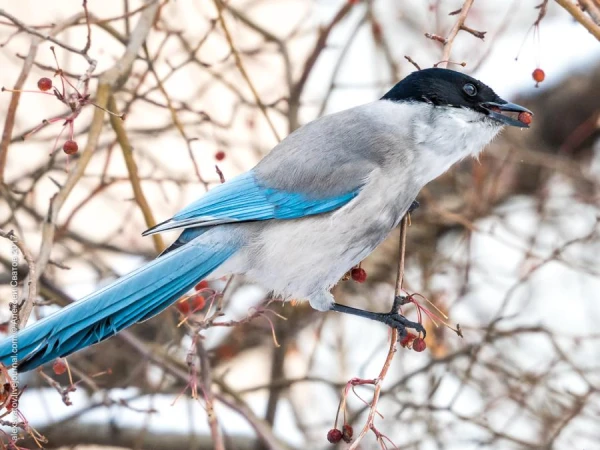
The blue jay is willing to share food with those in need, even without a request.
It was previously believed that mutual aid was an exclusively human trait. Bees and ants were not considered, as their assistance was directed only towards members of their colony. Even in cases where help was observed in other animals, such actions were explained by kinship ties.
However, over time, data has emerged indicating that some animals help each other without having familial bonds.
Blue jays, found on the Iberian Peninsula and in Southeast Asia, exhibit such behavior. (These jays resemble common ones but differ in having shorter beaks and legs, as well as different coloration.) Researchers from Utrecht and Vienna universities recently observed that blue jays share food with their kin. In their new article in the journal Scientific Reports, the scientists report that the jays not only assist in finding food but also assess who needs their support the most.
During the experiment, the jays were offered a multitude of mealworm larvae. Near one jay were two others: one of them also had larvae, while the other did not. The first jay could transfer food to both by extending the larvae through the wire mesh cells between the enclosures.
Overall, the jays shared food with both neighbors, but they most often gave food to the one who had none. If the foodless jay asked for food from others, it was shared with more frequently, but help was also provided in cases where it did not ask. Males and females exhibited slightly different habits: females primarily shared with the unfortunate neighbor, sometimes ignoring it, while males always gave something to the jay that was left without food. The authors of the study suggest that it is advantageous for males to demonstrate their generosity, as it makes them more attractive to potential mates.
Thus, blue jays are capable of assessing the situation of their kin. If luck has turned away from a companion, they show sympathy and try to help in difficult situations. However, it is wise to speak cautiously about sympathies and antipathies — the true motives of the birds remain unknown. Perhaps the jays are counting on a favor in return. A similar behavior is observed in vampire bats: they also share food with their kin, but some do so more readily than others. Studies have shown that stingy vampires cannot expect help in the future. Nevertheless, examples of such mutual calculations can also be found in the everyday lives of many of us.