
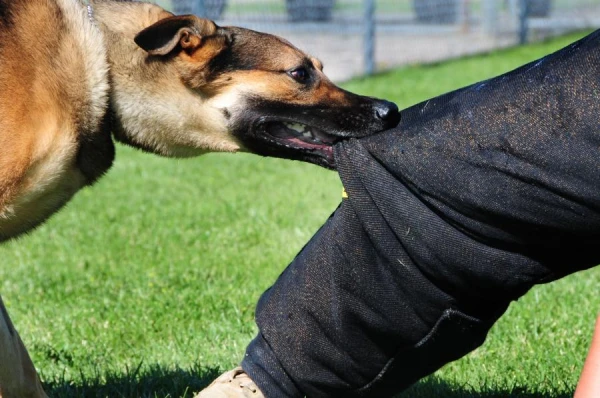
Sometimes even the calmest and most trained dog suddenly begins to attack other animals or bite its owners, family members, and those around it. This behavior is called aggression. However, aggression in an animal does not arise "suddenly" or "unexpectedly." In such cases, strict collars, choke chains, and shock devices will not help.
In order to correct the behavior of your four-legged friend, it is necessary to first determine what exactly is causing such a reaction.
It is believed that the main causes of aggressive behavior in dogs are pain, fear, and protection. Animal behavior specialists add three additional factors to this: learned aggression, redirected aggression, and central nervous system (CNS) disorders. Let’s take a closer look at each of these causes.
Pain
Research by Swedish dog behavior expert Andreas Hallgren, who has been working with animals since the 1970s, shows that more than 70% of cases of aggression are related to pain experienced by pets.
This is especially noticeable during sudden outbursts of aggression. For example, if a dog used to allow its paws to be washed or its nails to be trimmed calmly, but now starts growling. In such cases, it is worth paying attention to the condition of the skin — perhaps the animal has cracks or irritations. Joint, bone, or ligament injuries can also be a cause of aggression.
Another example: if a dog previously reacted calmly to being petted on the back, but now flinches or walks away, this may indicate problems with the musculoskeletal system or skin diseases.
How can you help your pet in such situations? The answer is simple — you need to consult a veterinarian. If the owner does not know which specialist to consult, it is best to start with a general practitioner who can suggest further steps.
Fear
Dogs, like humans, are afraid of everything unknown and unpredictable. An unfamiliar sound, such as an unusual car horn, can frighten a pet. Or it could be a familiar sound that occurs unexpectedly, such as a crinkling plastic bag. Strange silhouettes that the dog has not seen before, like a person in a long coat or a wide-brimmed hat, can also provoke fear.
Fear can also be associated with negative experiences from the past.
For instance, if a child once hurt a dog, it will be afraid of all children of the same height. If a scooter once ran over the animal, in the future, not only scooters but also bicycles, rollerblades, and skateboards will evoke fear.
How can this problem be solved? First of all, it is necessary to eliminate the source of fear. If this is not possible, it is advisable to take the dog to a safe distance and try to calm it down. You can offer it something to chew on or engage it in a game that requires concentration, such as asking it to find an object by smell.
To avoid similar reactions in the future, it is recommended to consult a behavior specialist who will develop a program to work with fears.
The main methods of working with fear are desensitization to the object of fear and counter-conditioning, that is, replacing negative associations with the stimulus with positive ones.
Those who have just acquired a puppy or are planning to do so should prepare a socialization plan in advance. This should include familiarization with new places, objects, and people — this will help avoid problems with fears in the future.
Protection
What exactly does a dog protect that can lead to aggression? The answer: personal boundaries, territory that it considers its own, resources, and offspring.
“Cuddly” toy breeds and puppies are particularly vulnerable to violations of personal boundaries — it is hard to resist the urge to pick them up or pet them. Often, such pets become models for hairstyles, fur dyeing, or tattoos. It is not surprising that at some point, the dog may not appreciate these efforts and bite — not every animal enjoys such procedures. Also, not everyone likes it when a dog licks their face, although for the animal, this is a display of joy and affection.
To avoid aggression when protecting personal boundaries, they need to be respected. It is important to observe what actions cause discomfort to the pet and to try to avoid them. The exception is hygiene and veterinary procedures, to which the dog should be accustomed from an early age.
When protecting its territory, dogs usually limit themselves to a short warning bark, which stops if they believe the threat has passed. The same applies to the protection of resources such as food, bedding, toys, and even family members.
Yes, an owner is also a resource for a dog, necessary not only for obtaining food but also for emotional closeness, which is extremely important for the pet's well-being.
To avoid provoking a dog to protect its resources, it is worth studying the typical characteristics of its breed. For example, one of the rules of interaction that a puppy learns from its mother states: “Everything in your mouth is yours.” Therefore, you should not take a bone away from a dog, stick your hand into its bowl, or try to take a toy that it is chewing on.
For the same reason, an owner should not pull a sock away from a dog if the four-legged friend has decided to chew on it. Remember: if the sock is in the pet's mouth, it belongs to them. This is not a reason to allow the animal to ruin the owner's belongings — it is necessary to understand the reasons why the dog constantly steals or picks up trash on the street.
Protecting territory, as long as it is not too loud and does not disturb neighbors, is normal. The same goes for protecting offspring — this is an innate mechanism necessary for the survival of the dog as a species.
Learned Aggression
This type of aggression is almost always formed by humans.
Imagine a situation: a dog enjoys lying in its owner’s chair, but the owner tries to drive it away. The pet flattens its ears, turns away, starts to grumble, and tenses up, pushing its paws against the chair.
In response, the owner tries to forcibly remove the dog, and it bites him, after which the person retreats. After several such repetitions, the dog understands that there is no point in showing the entire chain of signals, and it is better to use the last option immediately. Often, such behavior, especially if bites involve children, leads to abandonment of the pet and even euthanasia.
Fortunately, learned aggression can be eliminated. However, it is important to understand that it takes only two or three repetitions to form such behavior, while correcting the situation may take months, and it is better for professionals in animal behavior psychology to handle it.
Redirected Aggression
In simple terms, this is when a dog cannot express aggression towards the actual offender and redirects it to more accessible objects.
For example, if a dog does not like being brushed for mats, it may bite not the owner's hand, but the brush, even though it understands that the process is controlled by a person.
This happens either because the pet trusts the owner and forgives him, but needs to vent its frustration somewhere, or due to fear of the person who is strict with it, but cannot hold back the emotion. Although sometimes the brush is just the first thing that came under its paws, and if it were a little shorter, the owner's hand would have been bitten.
Thus, sometimes the reason for such behavior is obvious, while at other times it is a tangled ball of learned and redirected aggression, which can only be unraveled by a specialist.
CNS Disorders
This is the most complex case. Due to various disorders, the animal's impulse control decreases, making it difficult for the dog to “hold itself together.” Sometimes this is accompanied by hallucinations that can trigger fits of rage.
Diseases in which aggression may manifest include meningoencephalitis, epilepsy, neuroses, compulsions, as well as injuries or pathologies of the brain.
The only solution in such a situation is to consult a neurologist who will prescribe a treatment course. It is possible that the pet will have to take medication for life, but this will allow it to live peacefully and interact with those around it.
















Leave a comment