
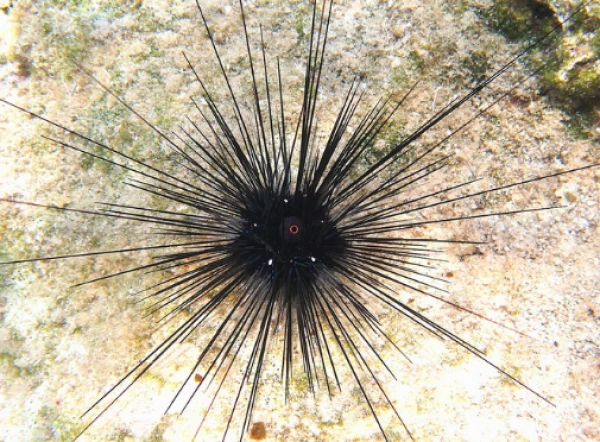
The skeleton of echinoderms is complex, consisting of many elements.
The skeleton of sea urchins, like that of all echinoderms, is primarily composed of calcite – one of the forms of calcium carbonate. Echinoderms are not particularly original in this sense: calcite is one of the most common biominerals, found in the shells and skeletal structures of many living organisms, from calcareous algae to mammals. However, in echinoderms, calcite forms a completely unique structure called stereom. This is both a three-dimensional lattice and a monocrystal that begins to form from an amorphous liquid precursor substance. It hardens in such a way that it does not form crystalline facets – all surfaces in the stereom are rounded.
The skeleton of echinoderms is complex, consisting of many elements, but each element is a calcite monocrystal-stereom. The struts in its lattice and the size of the pores between them vary depending on the specific biological species, the skeletal element, and even within the same element. It is this variability of the three-dimensional lattice of the stereom within a single element that is related to the electrical phenomenon described in a recent article in Nature.
Researchers at the City University of Hong Kong experimented with the spines of the sea urchin Diadema setosum. A stream of water was directed at its spines (which can be quite long, up to 70 cm) while they were submerged in water, or seawater was dripped onto them after removing the urchin, so to speak, onto dry land. In both cases, an electrical voltage of 30–120 millivolts arose between the base and the tip of the spine, and this occurred equally in both live and dead urchins. The pores in the stereom of the spines change from the base to the tip – they are larger at the base. The researchers concluded that the gradient in pore size creates this electrical effect. Water flows through them, but the flow rate in the smaller pores is greater than in the larger ones. As a result, the properties of the electric double layer formed by oriented polar molecules at the phase boundary, that is, at the interface between the spine and the water, differ.
For an electrical voltage to arise between the tip and the base of a sea urchin spine, the spine must be in a flow of water; if the water stops moving, the voltage disappears. The voltage arises quickly, within 88 milliseconds. Sea urchins could sense electrical changes on their spines to better navigate the water currents around them. However, the sensations of the urchins still need to be studied; so far, the researchers have only described a curious hydro-mechano-electrical phenomenon.
The pores in the spines should naturally be empty, and the authors of the study claim that they were indeed empty, even in live sea urchins, yet many specialists believe that the pores of the stereom in echinoderms are filled with living cells. Therefore, it remains to be further confirmed that water can indeed flow through the stereom that forms the spines. But regardless of the situation with the urchins themselves, this phenomenon could be utilized, for example, in sensors that operate in aqueous solutions.













Leave a comment