
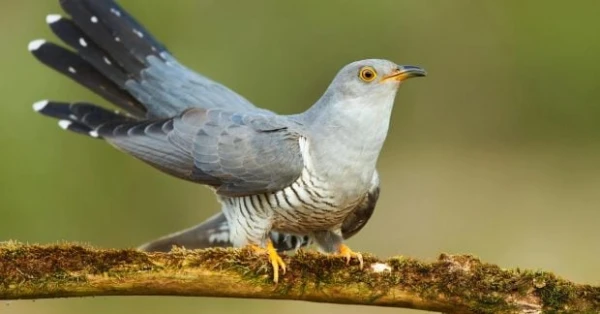
An international group of ornithologists has definitively disproved the widespread misconception that cuckoos carry eggs in their beaks. New video monitoring data showed how these birds lay eggs directly in the nests of other species, even in hard-to-reach places.
An international team of ornithologists has successfully disproved one of the oldest beliefs in natural science. For the first time, scientists have documented the egg-laying process of common cuckoos directly in the nests of other birds located inside tree cavities. The study, published in the journal Animal Behaviour, presented compelling evidence that cuckoos do not carry eggs in their beaks, as was believed for centuries.
Led by Associate Professor Robert Thomson from the University of Cape Town and Professor Tomáš Grim from the University of Ostrava, the team of researchers employed video monitoring. They recorded over 60 instances of egg laying over four breeding seasons in Finland. The focus was on the interaction of common cuckoos with their hosts — common redstarts, which prefer to nest in closed tree cavities rather than open cup-shaped nests.
Professor Grim emphasized, "These observations finally allow us to see what actually happens during egg laying in complex nesting conditions. For centuries, this gap in knowledge has been filled with assumptions. Now we have direct evidence."
Two Distinct Egg Laying Strategies
The study revealed that cuckoos employ two unique strategies when parasitizing in tree cavities. Sometimes females lay eggs while outside the entrance to the nest, literally "shooting" them inside. In other situations, they enter the nesting chamber just before laying.
Notably, each of these strategies comes with specific trade-offs. Laying eggs from outside reduces the risk of getting stuck inside the cavity but increases the likelihood of missing the target. At the same time, entering the cavity ensures precise placement of the egg but carries the risks of damaging the nest or getting stuck themselves.
Professor Grim explained, "We found that direct laying inside the cavity has a higher success rate but also greater potential costs. This balance likely explains why both strategies are maintained in the population."
The findings significantly deepen our understanding of the evolutionary "arms race" between brood parasites and their hosts. Cavity-nesting species, such as the redstart, gain an advantage through enhanced protection against parasitism. However, cuckoos, in turn, have developed remarkable behavioral flexibility to successfully overcome these barriers.
Associate Professor Thomson noted, "This is a rare example of explicit behavioral variability within a brood parasite species. It highlights how adaptable these birds are to various ecological constraints."
Debunking a Centuries-Old Myth
One of the key takeaways from the study was the definitive refutation of the centuries-old belief about cuckoos. It was previously thought that they carried eggs in their beaks to place them in the nests of their hosts. Lead author Michal Kysucan stated, "In older literature, the transfer of eggs was often presented as a fact, despite the lack of evidence. Our recordings convincingly show that cuckoos lay eggs directly in nests, even in situations where carrying might seem easier."
This myth, rooted in the works of early naturalists, including Aristotle, has persisted for centuries. Its longevity was attributed to the exceptional difficulty of observing the egg-laying process in hidden nesting sites.
Why This Matters
Understanding the mechanisms by which brood parasites adapt to various nesting conditions is fundamentally important. This is critically relevant for broader ecological and evolutionary studies. The data show that even well-studied species can exhibit previously unknown complexities in their behavior.
The application of large-scale video monitoring of hundreds of nesting boxes was a decisive factor in the success of this project. It underscores the immense value of long-term high-resolution behavioral data in ecology.
Associate Professor Thomson concluded, "Such detailed observations are necessary if we want to fully understand species interactions and their implications for biodiversity."









Leave a comment