
In a number of countries, raccoons pose a serious problem. These cunning creatures have long ceased to fear humans and often appear in cities in search of food. In the suburbs, they can be seen rummaging through garbage containers, and some studies claim that 87% of damaged crops in the U.S. have fallen victim to raccoons!
Raccoons are omnivorous creatures. These animals are ready to eat anything that comes their way! However, these thieves have one interesting feature — they love to wash their food. Why do they do this?
What Raccoons Eat in the Wild
Raccoons actively consume a variety of fruits and berries, hunt small animals such as mice, rabbits, frogs, lizards, and insects. Near water bodies, raccoons can catch fish and crustaceans to provide themselves with protein. Sometimes they also hunt birds and eat their eggs. The diet of these animals can be quite diverse and depends on their habitat and seasonal changes.
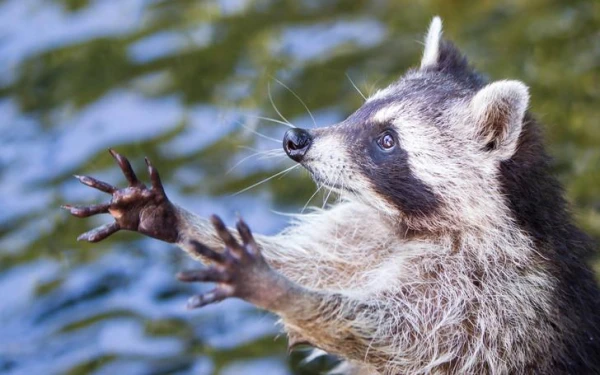
Scientists have long studied the dexterity of raccoon paws, as these animals have five well-developed fingers, even though they are not primates. In the wild, raccoons almost always wash their food, carefully rinsing it with their paws in water. This habit is not typical for most animals, which is why back in 1961, researchers from the London Zoo attempted to find out what lies behind this behavior. Perhaps they are cleaning their food of parasites?
Studies have shown that raccoons wash meat more often than plant food, but these movements are not sufficient to remove dirt or parasites. Even in the absence of water, raccoons in captivity moved their front paws as if they were actually “washing” food. This led scientists to think that raccoons are not cleaning their food, but that there is something else at play.
Some researchers suggested that raccoons lack saliva, and they moisten their food to make it easier to eat and digest. However, this hypothesis has also not been confirmed. Recent data suggest that such behavior enhances the tactile sensations associated with eating.
So why does a raccoon wash its food?
We did not mention the anatomical features of raccoon paws by chance. These animals have the same group of nerves on the hairless parts of their front paws as primates, including humans. This makes them very sensitive to touch.
Like primates, raccoons have slowly adapting nerves on the hairless or bare parts of their bodies. These receptors respond to skin displacement, transmitting information about weight, size, texture, and temperature of everything concerning these body parts to the brain through the central nervous system.
In a study dedicated to examining slowly adapting nerves in the front paws of 136 raccoons, scientists found that moistening the skin increases receptor sensitivity. Water on the paws of raccoons can activate the nerves faster and stronger, giving the animals more vivid tactile sensations and providing accurate information about what they are about to eat. This is a useful trait since raccoons do not have the best eyesight.
Why don’t primates wash their food?
One interesting difference in tactile perception between raccoons and primates is the absence of papillary ridges in raccoons. These microstructures on the skin help us feel friction (they also leave fingerprints). On the hairless areas of human skin, the ridges are filled with Meissner's corpuscles (receptors) that respond to sensations such as pressure or tension. Therefore, primates, like us, do not need the help of water.








Leave a comment