
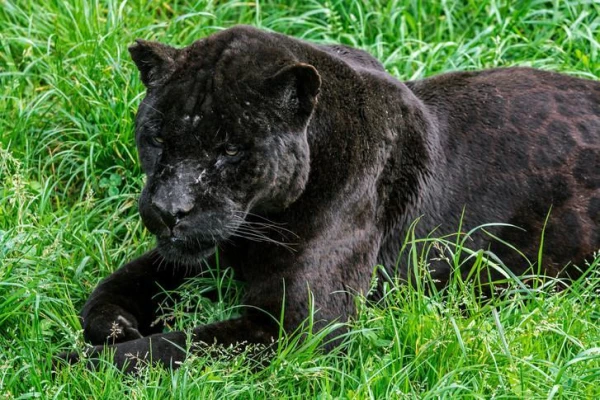
It is spotted.
“Definitely black!” many of your acquaintances will say, recalling the numerous films and cartoons featuring this animal. However, they would be wrong.
First of all, there is no biological species called “panther.” Instead, there is the genus Panthera in the cat family, which includes four species: Panthera leo (lions), Panthera tigris (tigers), Panthera pardus (leopards), and Panthera onca (jaguars). As for the origin of the term panthera, one of the most common versions suggests it comes from the Sanskrit word pandarab (“light yellow”). Originally, this word was used to refer to the tiger.
The ancient Greeks adapted this word to panthera, but for them, it referred not only to large members of the cat family (by the way, lions still roamed in Greece at that time) but to all animals, both real and mythical. Hence, the word “panther” made its way into heraldry, where it denoted a glorious multicolored beast with a cute face (albeit a fire-breathing one).
As for black panthers, they do exist, but they are not a separate species; rather, they are a genetic color variant of certain female leopards (in Africa and Asia) or jaguars (in South America). The coat of such a “panther,” upon closer inspection, is not black but very dark and spotted. Male leopards and jaguars are never black; their offspring from “panther” females can be either light or dark. However, the latter are born extremely rarely, as the black color gene is recessive.
It is worth noting that in the United States, the term “panther” often refers to the black cougar, but no specimen of a black cougar has been officially recorded so far.











Leave a comment