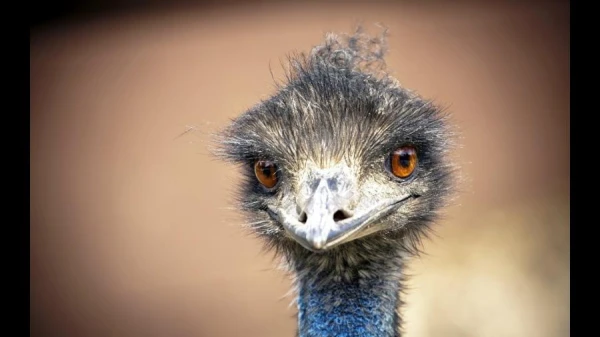
Not only poor ostriches are forced to move on their two legs instead of flying as birds are supposed to. From childhood, we are misled by the claim that cowardly ostriches bury their heads in the sand when danger arises. But is this really the case?
The great naturalist Alfred Brehm noted:
“The cowardice of this large and powerful bird is beyond doubt. The ostrich quickly runs away from any unusual phenomena, but is unlikely to adequately assess danger and is frightened even by completely harmless creatures.”
What does an ostrich do when it is pursued by a predator?
The ostrich stands out not only for its unusual appearance and impressive size. It has powerful legs with strong claws for protection against enemies. One kick from such a leg can send almost any predator in Africa to its ancestors.
However, fighting is a last resort. Ostriches prefer to run away from problems on their two legs. This bird is the fastest and most enduring bipedal creature, capable of reaching speeds of a car — 60-70 kilometers per hour — and maintaining that pace for over half an hour. Even young ostriches keep up, and month-old chicks can reach speeds of up to 50 kilometers per hour.
Where did the myth about ostriches burying their heads in the sand come from?
The common misconception that ostriches supposedly bury their heads in the sand to hide from predators first appeared in the works of the scientist Pliny the Elder (in the work “Natural History”), where it is stated:
“Ostriches believe that when they stick their heads and necks into the ground, their whole body becomes invisible.”
5 Facts About Ostriches That Will Surprise You:
1. Most birds lack a sexual organ, and during mating, there is a simple alignment of the cloacal openings of the male and female. However, among the few feathered creatures that evolution has left with a penis are male African ostriches.
2. Ostriches are the only birds that can survive without water. They obtain all the necessary moisture from their food.
3. Ostriches can go without sleep. They can sleep standing up, closing their eyes only for short periods of time.
4. These birds can survive without food for several weeks. They use the fat stored in their bodies for energy.
5. Ostriches are the only birds that can do without a beak. Why do they need one when they have two powerful legs?
Why do ostriches lower their heads to the ground?
Not to burrow:
When the bird gets tired from running, it lies down and stretches its neck along the ground. From the side, it may seem that the ostrich has buried its head in the ground.
In an attempt to hide from danger, an ostrich may also press itself to the ground and lower its head. But it does this not to burrow, but to become lower and less noticeable.
The ostrich has excellent vision, allowing it to survey the surroundings of the savanna for several hundred meters. However, after the rainy season, the dense tall grass becomes an excellent place for predators to ambush. Therefore, ostriches have adapted and from time to time press their ears to the ground to listen.
The ostrich is a large bird, and it needs a lot of food. Food grows, lies, crawls, and runs on the ground. Additionally, one should not forget to pick up small stones from the ground, which are necessary for digestion.
Nevertheless, Pliny's tale was so appealing to Europeans that the metaphorical expression “to bury one’s head in the sand” can today be found in the languages of almost all peoples of the Old World. Only “the head in the sand” is not buried by ostriches, but by people. This is said about those who ignore problems, hoping they will resolve themselves.