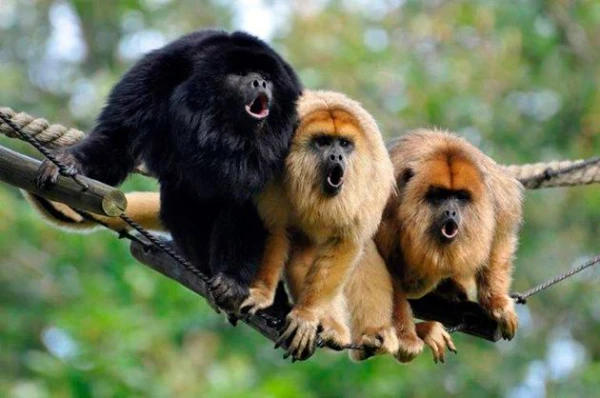
About 25 million years ago, the common ancestor of humans and great apes separated from other monkeys and lost its tail. Scientists have yet to discover the genetic mutation responsible for this significant change in our anatomy.
However, researchers from the Institute of Computational Medicine and the Institute of Systematic Genetics at New York University (USA), whose work is published in the journal Nature, have finally identified a unique mutation in the TBXT gene, which is responsible for tail length in tailed animals. This mutation led to the loss of tails in our ancestors.
Scientists found that in great apes and humans, there is a segment of DNA in the TBXT gene that is absent in tailed monkeys. This genetic sequence alters the structure of the protein encoded by the TBXT gene. At the same time, the gene continues to encode the previous version of its protein. As a result, both versions of the TBXT protein are present in the cells of humans and great apes, which prevents tail formation, the researchers concluded.
Evolutionary biologists suggest that it was the loss of the tail that allowed our distant ancestors to begin moving on two legs. However, perhaps in return, we as a species paid the price of an increased risk of developing spina bifida — a congenital defect affecting the neural tube from which the spinal cord and brain develop. This condition occurs in about one in a thousand newborns worldwide.
The hypothesis linking tail loss and increased risk of spina bifida arose among researchers based on experiments with laboratory mice: animals with a “tailless” mutation in the TBXT gene indeed lacked tails but exhibited embryonic neural tube defects more frequently.