In Madagascar.
Since childhood, we have been fascinated by the famous journeys of Sinbad the Sailor. This mythical character experienced many amazing adventures. His journey on the enormous roc bird alone evokes admiration and bewilderment. However, despite its fantastical nature, this story has certain historical roots. It is known that many tales about Sinbad are based on records made by Captain Buzurg ibn Shahriyar.
This Arab captain was a real person who lived in the 10th century and recorded stories of distant lands that he heard from travelers, merchants, and captains. He tried to separate truth from fiction, and in his works, he typically described not fictional but actually existing countries, with narrators being his contemporaries.
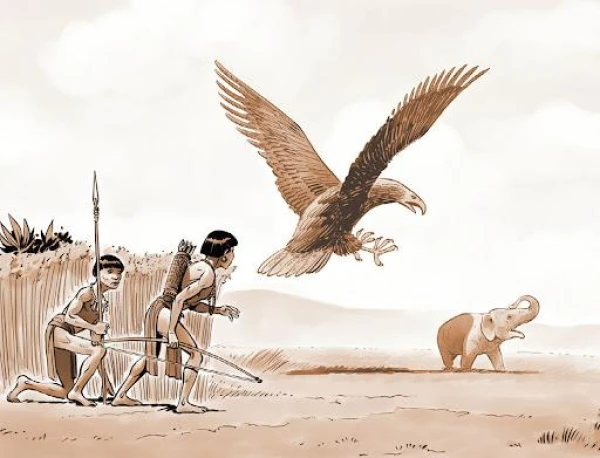
It is noteworthy that in the records of Buzurg ibn Shahriyar, giant birds are mentioned, and the main plot line completely coincides with Sinbad's tales about the roc bird. For people of the Middle Ages, the existence of this bird was quite natural. On maps created based on Marco Polo's descriptions, there were even islands marked where the roc bird lived. This traveler indicated the exact location of its habitat. Speaking of the fauna of Madagascar, Marco Polo wrote that a giant griffon lives on the island:
“The griffon is very strong and large; it can seize an elephant and carry it high into the air, then drop it to the ground, where the elephant will break; after that, the griffon pecks at it, eats it, and enjoys it... It should also be noted that on the islands, it is called ruk.”
It is not surprising that Madagascar came to be considered the homeland of the roc bird. Indeed, enormous birds lived here, not in the age of dinosaurs, but quite recently — they were exterminated about 400 years ago.
The prototype of the roc bird was the giant ostrich, the elephant bird, or vouron patra, as the locals called it. Although it did not feed on elephants and could not fly, it had all the characteristics of the roc bird, such as enormous height and eggs of incredible size. Three-meter elephant birds laid eggs with a volume of up to 8-9 liters.
Locals sometimes used the eggshell as water barrels. Finds of these eggs are encountered in the peat bogs of Madagascar. European science became aware of the existence of the Madagascar roc bird in the mid-19th century when scientists obtained eggs and bones of the elephant bird.