Did you know that geese not only saved the Romans who took refuge in the fortress on Capitoline Hill during the barbarian invasion? During the Cold War, these birds were used to guard military facilities in West Germany, and the royal guards of England accepted a goose into their ranks. Nowadays, Chinese border guards also use these birds to patrol the state border.
The Geese That Saved Rome
The ancient Roman historian Titus Livius described how the residents of Rome, who survived the Gallic invasion, were able to take refuge in a fortress on the Capitoline Hill. The siege lasted for six months, and one night the Gauls attempted to secretly attack the weakened defenders. No one noticed the approach of the enemy, except for the geese that lived near the temple of the goddess Juno. They began to honk loudly, waking the guards, and the Romans were able to successfully repel the attack. Since then, there has been a saying: “The geese saved Rome.” This expression is commonly used when luck helps to avoid serious trouble.
A Goose in the Ranks of the Royal Guard
There are known cases of geese being used in warfare in later times as well. In 1838, a goose named Jacob saved British guards sent to suppress a rebellion in Canada. He raised the alarm and prevented the insurgents from unexpectedly attacking the English under the cover of a snowstorm. Jacob returned to England with his regiment and served for another 8 years at the Wellington Barracks.
Experiments by the American Military
During the Cold War, geese began to be purposefully used for guarding facilities. Specifically, both American Marines and North Vietnamese soldiers placed pens with birds around the perimeter of camps to ensure that the enemy would not pass unnoticed.
In 1986, Time magazine described a pilot project by the 32nd Air Defense Command in West Germany. It started with 18 feathered guards, and it was planned to increase the number to 900 birds, which were to patrol the facilities in “platoons” of 6–40 individuals.
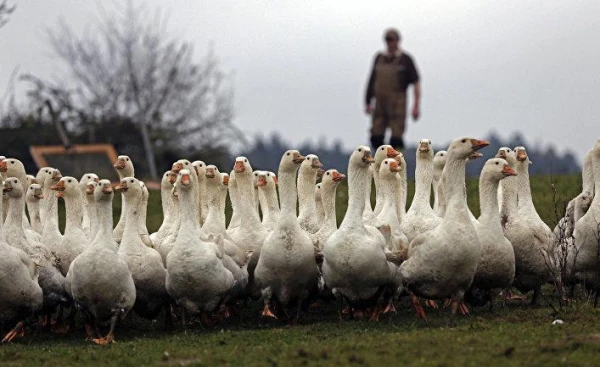
The project had a serious technical and economic justification. According to calculations by the U.S. Department of Defense, maintaining a patrol group of geese was twice as cheap as keeping a guard dog. Geese have excellent vision and can see in the ultraviolet spectrum. Unlike dogs, they are better at distinguishing fine details. While sleeping, geese keep one eye open, and the hemisphere of their brain that controls it remains alert, which scientists refer to as unihemispheric slow-wave sleep.
Geese are territorial birds that fiercely defend their territory and can distinguish between their own and strangers, including people in military uniforms. Three breeds were recognized as the most suitable for guarding: the Roman tufted (the same one from the temple of Juno), the Chinese, and the saddleback Pomeranian.
The Scottish Watch
The idea of using geese for guarding facilities was likely borrowed by American military personnel from Scotland. This is believed by the authors of the military.com portal. Major General Victor Joseph Hugo Jr. of the 32nd Air Defense Command sent his assistant to the Ballantine’s distillery in Dumbarton, Scotland, to assess the feasibility of using geese for security. In this city, the birds guarded a vast area of a warehouse where whiskey worth millions of British pounds was stored. The owners primarily used Chinese and Roman breeds. During their service, the geese from Dumbarton repeatedly proved their effectiveness. Locals began to call them the Scotch Watch (scotch — Scottish whiskey, watch — guard). This name stuck, and the flock of guard geese gained star status: tours were conducted at the warehouses, television segments were filmed about the birds, and they were written about in British newspapers.
The geese guarded the distillery warehouses for about 50 years. Only in 2012 were the last 7 individuals retired and integrated into the flock of Glasgow Green Park in the east of Scotland's capital. In memory of the guard birds, a monument was erected at the warehouse in 2020.
On the Border
Nowadays, Chinese police have started using geese in rural areas. During the day, they are kept in a pen so they do not attack visitors, and at night they are released to patrol the area around the police station buildings. Additionally, Chinese authorities actively use feathered guards to patrol the border with Vietnam. During the COVID-19 pandemic, in addition to dogs and drones, about 500 geese were used to guard a 533-kilometer section of the border near the city of Chongzuo, as reported by National Geographic magazine. According to Russian ornithologist Petr Glazov, geese may have advantages over dogs, as they are more selective in signaling alarm. Dogs may bark just for fun or to communicate with their peers, while geese make noise only if an outsider enters their territory.