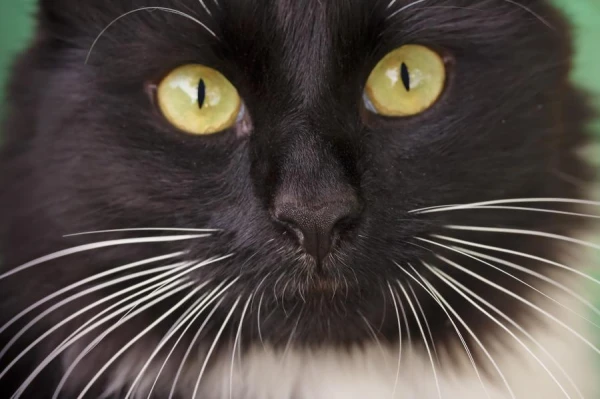
When the lights go out in a room, it takes us time to adapt to the darkness, but even after that, we cannot distinguish all the details. How and why do cats and other animals manage to do this?
Each species of animal has its own rhythm of sleep and wakefulness. Some predators prefer to hunt during the day, while others are active at night. In warm regions, daytime temperatures can be too high, making hunting difficult. At night, however, ideal conditions are created for catching prey: a comfortable temperature and the fact that predator victims are usually asleep. As a result of this regime, nocturnal predators have developed the necessary skills for successful hunting in the dark.
The human eye allows light to pass through the pupil, which is an opening. The lens inside the eye focuses the image on the retina. The retina can be compared to a wall onto which the image is projected. It consists of two types of cells: rods and cones, which capture light and transmit information about the image to the brain.
Rods effectively respond to very low light and detect movement, but they cannot distinguish colors. The colored image that our brain receives from the eye is formed by cones, which only work under sufficient lighting. At the same time, there are four times more rods in the human eye than cones.
This ratio allows us to see well during the day. Despite having fewer cones compared to rods, their number still exceeds that of some animals. During the day, we can distinguish many colors and see quite clearly in the dark. However, other animals, which have a larger number of rods and fewer cones, are able to see even better in the dark, even if their color perception is not as developed.
Based on materials from All About Eyes.