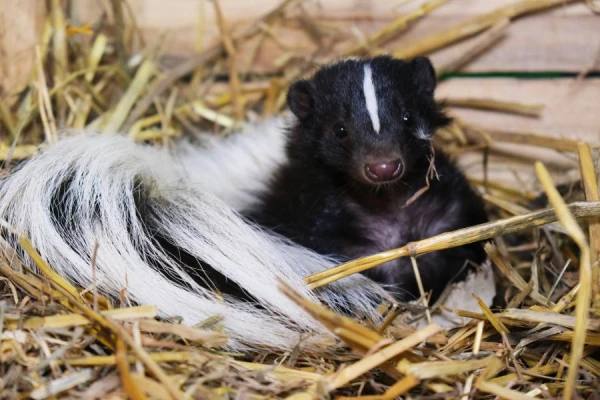
Skunks have a bad reputation, yet behind these charming creatures lie amazing chemical properties and unusual behavior.
1. THE STRIPES OF A SKUNK INDICATE THE SPRAYING LOCATION
If you think that the stripes on a skunk's body indicate the source of its toxic spray, you are correct. A study conducted in 2011 showed that animal species that prefer to fight off predators instead of fleeing often have markings that draw attention to their defensive mechanisms. Thus, the stripes of a skunk are positioned to emphasize its ability to spray a defensive secretion in response to a threat.
2. SKUNKS PERFORM A WARNING DANCE
If the stripes do not work, a skunk may try to deter a predator with its unique dance. Aiming to avoid spraying its scent, which would make them vulnerable until they 'reload', skunks perform a series of maneuvers intended to intimidate: they stomp their feet, slap their tails, and may even stand on their hind legs.
3. SKUNKS HAVE DEVELOPED THEIR STINKY EFFECT DUE TO A NOCTURNAL LIFESTYLE
Why have skunks evolved with such a defense while other animals, like meerkats, rely on numerical superiority? Skunks lead a nocturnal and solitary lifestyle, making them more vulnerable to ground attacks; their ability to spray and stun predators proves quite effective in the event of a surprise attack.
4. A SKUNK'S SPRAY IS A POWERFUL WEAPON
Skunks can spray their foul-smelling secretion up to three meters from their anal glands. This odor lingers for several days (or even weeks) and causes intense irritation, as well as temporary blindness in those caught in the spray. Even from a significant distance from the spraying site, people can smell it up to one and a half kilometers away downwind.
5. IT IS ALSO FLAMMABLE
Flammability is a side effect of the skunk's 'chemical weapon', which consists of thiols, sulfur-based compounds also found in garlic and onions.
6. CHEMICALS CAN HELP REMOVE SKUNK SMELL
If a skunk sprays you (or, more likely, your dog), simple soap and water won't help. There is a belief that tomato juice can help eliminate the smell, but in reality, it merely masks it. To completely remove the odor, the chemical composition of the thiols must be altered, which can be done with a mixture of baking soda and hydrogen peroxide.
7. SOME PEOPLE CANNOT SMELL SKUNK ODORS AT ALL
And this is not due to a lack of smell. Specific anosmia, or insensitivity to a particular odor, occurs more frequently than general anosmia. One in a thousand people is unable to detect the smell of a skunk.