
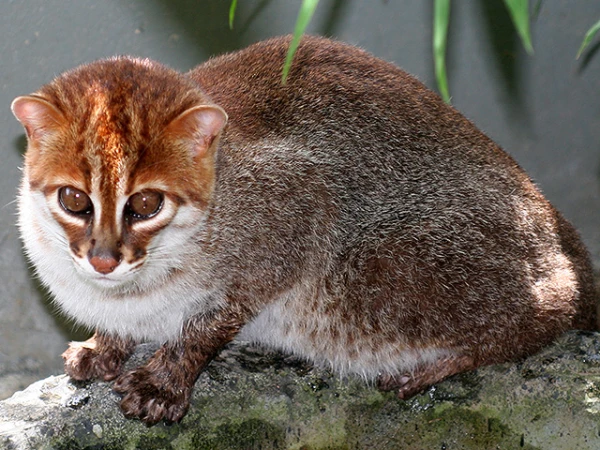
These small predators catch frogs and crustaceans, as well as rats and chickens.
In Thailand, after nearly three decades, the Sumatran cat has been rediscovered – a rare and endangered species. Moreover, not just one animal was found. The last confirmed sighting of this small wild cat, similar in size to a domestic cat and primarily feeding on fish, occurred in 1995 on the border with Malaysia. By 2014, due to the lack of new data, Thai authorities feared that the species had completely disappeared from the country.
However, as reported by Mongabay, co-chair of the IUCN Cat Specialist Group Urs Breitenmoser announced that traces of the Sumatran cat have been recorded again in the Princess Sirindhorn Wildlife Sanctuary.
The discovery is particularly significant due to the finding of a cub – this indicates that there is a small but viable population in the area. These cats are known for their elusive nature and prefer swampy forests that are extremely difficult to access. Last year, the organization Panthera, in collaboration with the Thai Department of National Parks, began research in the south of the country. Scientists had to navigate through peat swamps with water up to their chests and make their way through dense mangrove forests.
Despite the challenges, researchers set up camera traps that recorded 13 sightings of cats in 2024 and another 16 in 2025. Previously, only the outskirts of the forest were studied, so the new data suggest that there are more animals within the forest massif than previously thought.
It is particularly important to confirm that there is a cub in the population – as female Sumatran cats usually give birth to only one kitten. This means that there are adult individuals present in the region and successful reproduction of the species is ongoing.
The Sumatran cat has a slender body with elegant elongated limbs. Its head is more elongated and cylindrical than that of domestic cats. The distance from the ears to the eyes is quite large. The species has dense fur, reddish-brown on the top, dark brown on the body with white spots on the lower abdomen. The muzzle is lighter than the body, with a white stripe under the eyes from the nose to the corner of the eye, and the chin is also white. The cat's ears are rounded. Its eyes are large, positioned at the front and close together, which provides improved stereoscopic vision. A distinctive feature of the species is the pointed premolars, which are twice as large as those of domestic cats; these teeth are needed for catching slippery fish. Another feature is the claws, which are quite short and can only be partially retracted, with about 2/3 of the claw remaining exposed. The length of the head and body of the Sumatran cat ranges from 41 to 50 cm, and they have a short tail measuring 13–15 cm. The cat weighs only 1.5–2.5 kg.
Sumatran cats recorded in Kalimantan are most active at night, while in captivity, females were most active in the morning and evening. The species lives solitary and has its territory, marking it with its scent. It is assumed that their diet consists mainly of fish, but they have also been reported to catch frogs and crustaceans, as well as rats and chickens. The cat catches fish by fully immersing its head in the water and then carries the catch to the shore, where it eats it. They have been observed washing objects like raccoons.
The sounds made by the Sumatran cat are similar to those of domestic cats; they purr and make other short sounds.
The gestation period for the cat lasts 56 days, with one of three litters in captivity consisting of two kittens, while the other two had one each. In captivity, cats have lived up to 14 years.











Leave a comment