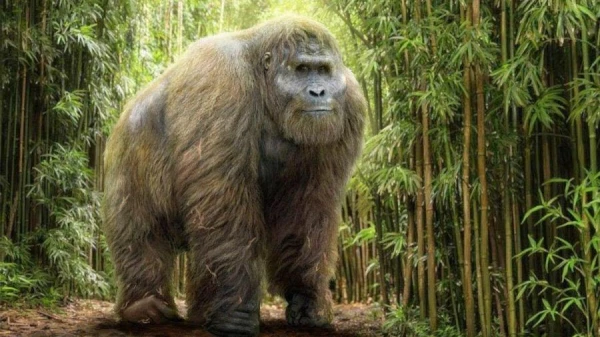
Gigantopithecus blacki was the largest primate to ever exist on Earth. Now researchers have likely found the answer to the question of what caused the extinction of this giant ape.
The first mention of Gigantopithecus was made by German paleontologist Gustav von Koenigswald in 1935. The scientist stumbled upon an unusual specimen in a Chinese shop specializing in traditional medicine. A tooth, dubbed the "dragon tooth," actually belonged to an unknown species of extinct ape, which the scientist named Gigantopithecus.
To date, the only evidence of the existence of these creatures consists of 200 fossilized teeth and four jawbones.
Gigantopithecus blacki is sometimes referred to as the "real King Kong" due to its colossal size. Adult individuals of this ancient ape could reach over 3 meters in height and weigh between 200 and 300 kilograms.
This giant primate inhabited the mainland of Southeast Asia 2 million years ago until it mysteriously disappeared.
What caused the extinction of Gigantopithecus blacki?
In a new study published in the journal Nature, scientists from Macquarie University collected samples of dust, fossils, and sediments from 22 caves in the Chinese province of Guangxi. The researchers applied six different dating methods to determine the time of the giant primates' extinction.
The analysis showed that 2.3 million years ago, the environment consisted of dense forests with thick vegetation, which was ideal for Gigantopithecus blacki and other jungle-dwelling primates. However, around 600,000 years ago, the climate in the region began to change — the forest-grassland ecosystem gave way to an open woodland environment.
Unlike its relatives, Gigantopithecus blacki could not adapt to the new conditions. The animal's teeth showed signs of chronic stress as the species began to go extinct. The giants' diet also became increasingly scarce due to the opening up and drying out of forests.
One of the key factors in the demise of Gigantopithecus blacki was its enormous size — it limited the primate's mobility in search of food.
The researchers emphasize that the climate is currently also undergoing changes, and large primates are losing their habitats due to human activity. Given the impending sixth mass extinction, understanding the fate of Gigantopithecus blacki may help in the conservation of modern monkey species.