
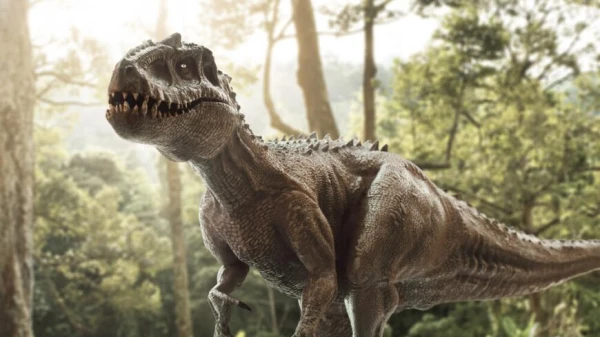
The first finding of the bone of an ancient reptile occurred centuries before the start of scientific inquiries by Europeans.
A group of scientists from the Universities of the Witwatersrand and Nelson Mandela in South Africa claims that the first "paleontologists" to discover dinosaurs were not British researchers, but the inhabitants of Africa. As evidence, they present the bone of Massospondylus, which was found and brought by a person to a cave at least 500 years before the English naturalist Robert Plot first scientifically described the remains of a dinosaur. The scientists emphasize that people had been finding fossils of ancient reptiles for hundreds of thousands of years prior. However, for some reason, Africans did not use them for rituals or medicine, as was done in Asia, but preserved them. The results of the study are published in Geological Society Publications.
Traditionally, the discovery of the first dinosaurs is associated with several European scientists who worked in the 17th century, when Plot described the femur of a giant creature in "The Natural History of Oxfordshire" (1677). However, the Briton could not determine to which creature it belonged. This stage concludes with the beginning of the 19th century, when geologist William Buckland and French naturalist Georges Léopold Chrétien Frédéric Dagobert Cuvier identified several fossils as the remains of a giant predatory lizard, sauria. In the interval between these discoveries, scientists accumulated enough fossil material to form an understanding of the animals of the Mesozoic era.
In the new study, the team gathered and analyzed data from archaeological, historical, and paleontological literature, concluding that interest in dinosaur fossils in Africa existed long before the 17th century. This was inevitable, the researchers argue, as Homo sapiens appeared about 300,000 years ago on the African continent.
In Africa, there are still many geological outcrops where native bedrock is exposed, revealing ancient fossils. For example, the Kem-Kem formation in southern Morocco, the Faiyum Depression in Egypt, or the East African Rift. Because of this, the remains of ancient dinosaurs were accessible to our distant ancestors even without modern excavation methods.
Centuries Before Cuvier
The authors of the study also note that scientists most often found dinosaur fossils in Africa not on their own — they were pointed to where to search by African guides and local residents. As an example, the researchers cite the dinosaur Jobaria, found by Tuaregs in Niger, and Giraffatitan, discovered by members of the Mwera people in Tanzania.
In Lesotho in the 1990s, archaeologists found in the rock shelter of the Stone Age Bolahla a cave where a phalanx bone of Massospondylus (Massospondylus carinatus) was stored. No fossils or protruding fossils were found in the walls of the cave, so part of the dinosaur's finger may have been transported there from the place where it was originally found.
The shelter in Lesotho is surrounded by hills and rocks of deposits that date back about 180–200 million years ago, when the first dinosaurs lived on Earth. It is known that Massospondylus — herbivorous ancestors of sauropods measuring 4–6 meters long with elongated necks and small heads — inhabited this part of Africa.
During the Middle Ages — from 1100 to 1700 — these territories were inhabited by local Khoisan and Basotho tribes. Heavy rains and weathering of rocks already abundantly revealed the remains of extinct animals to the inhabitants. The exact date when the bone was found by ancient humans remains a mystery, but it could have happened anywhere from the 12th to the 18th century, or much earlier. It is believed that the artifact was preserved by people half a millennium before Plot described the dinosaur bone.
Scientists offer various explanations for why this was done. A person might have brought the bone to their dwelling out of curiosity or intended to make something from it, such as an ornament or a toy.
It is also known that before the emergence of paleontology, people on different continents were aware of fossils and dinosaur tracks but interpreted them as belonging to dragons and other mythical creatures. For example, in Algerian folklore, they were attributed to the mythical bird Roc. However, unlike European, Asian, and American peoples, in Africa, dinosaur remains were rarely used in traditional medicine. Scientists need to find out where this unique trait of ancient African "paleontologists" comes from.













Leave a comment