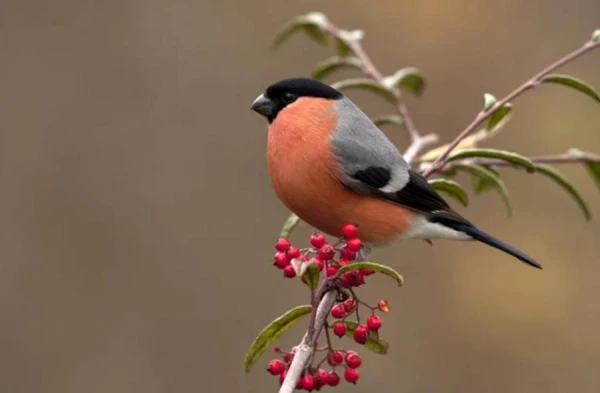
What do we know about the red-breasted bullfinch, besides the fact that its appearance at the feeder under the window signals the inevitability of winter? It is unclear why these birds return to places where the temperature remains below zero for a long time. A strange choice of resting place, don’t you think? Or perhaps they do not fly away at all? Then where do bullfinches disappear all summer? Let’s figure it out.
The bullfinch is primarily a sedentary bird. It only completely leaves its habitat in the northern taiga, where winter conditions become too harsh. However, not everywhere does the climate force bullfinches to leave their homeland even in winter. It is no coincidence that it has such a winter name — bullfinch, the snowy bird. At the same time, its Latin name “Pyrrhula pyrrhula” translates to “fiery”!
But only the males can boast bright plumage. Females prefer modesty and are dressed in gray-brown feathers. This makes them less noticeable to predators. Moreover, not every person can recognize the female bullfinch.
If they do not fly away, where do they disappear all summer?
One could say that if you do not see them, it does not mean they are not there. With the arrival of spring and warmth, bullfinches leave the city and move to nature, to coniferous forests, to finally fall in love, form a lifelong pair, and share the joys and challenges of raising chicks. Bullfinches breed from April to August, managing to lay two clutches of 5-7 eggs during this time.
And already in late autumn, with the first snow, the grown young under the supervision of adult birds head to the cities, closer to human dwellings and bird “cafés.” Here it is plentiful and the air is warmer.
The bullfinch will sit all winter with an important look on a tree, leisurely feasting on rowan berries. It is only interested in seeds — the pulp is not eaten by the bird. A friendly flock will leave one tree and move to the next only on the leader's command when he slightly lifts his wings, hops on a branch, and turns in different directions so that everyone can see his white spot on his lower back. This spot is a signal that it is time to fly to another feeding ground.