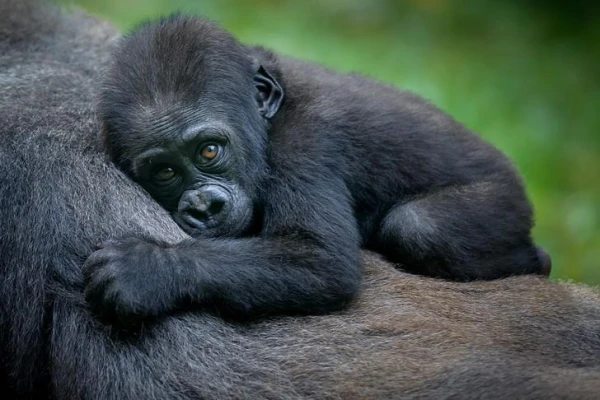
Grauer's gorilla (Gorilla beringei graueri) is a subspecies of the eastern gorilla. These primates weigh about 180 kilograms and are found exclusively in the eastern part of the Democratic Republic of the Congo (DRC). As a result of the bloody civil war in the country, their population decreased from 17,000 in the early 1990s to 3,800 in 2016, representing a 77% reduction.
According to available data, after the genocide in Rwanda in 1994, hundreds of thousands of refugees filled the territory of the DRC, leading to large-scale conflicts and armed clashes over mineral deposits. Illegal mining of coltan and gold has resulted in the destruction of gorillas.
“Many militants hide in the jungles from government forces. To secure their livelihoods, they start mining ore. And since there is not enough food in the jungles, they have to hunt gorillas,” explains Andy Plumtree in his report on gorillas. Unlike chimpanzees, which move through the trees, gorillas move in groups, leaving noticeable traces, making them easier to track.
However, a new study conducted by the Wildlife Conservation Society indicates that either the number of gorillas has increased naturally, or the previous expedition failed to cover all their habitats due to the military situation in the country. Currently, the population of Grauer's gorillas is estimated at 6,800 individuals, which is still insufficient but gives hope for population recovery.
Emma Stokes, director of the Wildlife Conservation Society in Central Africa, asserts that the killing of wild animals for meat remains the main threat to gorillas. Therefore, conservationists need to focus on educating the local population and involving them in the protection of endangered animals.