
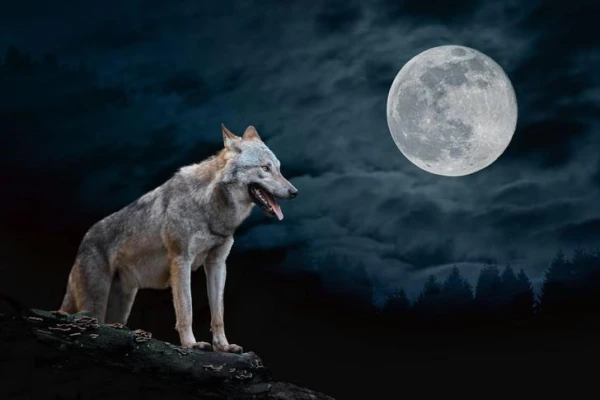
They do not care what exactly to howl at.
In fact, wolves do not howl at the Moon. Howling is a key means of communication and social activity for these predators. A howling wolf serves several purposes: it maintains the unity of the pack, helps coordinate its actions, confirms 'ownership rights' to a specific territory, conveys messages about found prey, and other important information for the pack.
It can be said that howling in the life of wolves serves roughly the same function as a horn, drum, and battle cries in ancient armies. The belief that wolves howl at the Moon likely arose for several reasons.
First, a howling wolf raises its head — this ensures a more even distribution of sound in different directions and helps other pack members determine where the sound is coming from.
Second, wolves most often howl at night, as this is when they are most active. In reality, they are not concerned with whether the Moon is in the sky: wolf howls can be heard during both new moons and cloudy nights, and sometimes even during the day. However, moonlit nights are usually quiet, and in calm weather, howls are heard much better. Additionally, only in the light of the Moon could people observe howling wolves — seeing them engaged in this activity in the wild is quite difficult, and almost impossible on a moonless night.













Leave a comment